



How to Deal With a Traffic Ticket Without Losing Your Nerves


Traffic tickets are not as trivial as people usually think of them. They have the potential to cost you a large amount of money, increase your insurance to a very high level, and even make your ability to drive disappear.
Most of the time, drivers are not aware of how fast a minor mistake can escalate to a major issue. We will now see what you should be waiting for and how to deal with them in a proper way.
Key Facts:
- Traffic tickets are divided into moving violations (e.g., speeding, red light violations) and non-moving violations (e.g., parking or registration issues).
- Moving violations can add points to a driver’s record, which may lead to license suspension depending on state rules.
- Most traffic tickets remain on a driving record for about 3 to 5 years, depending on severity and jurisdiction.
- Accumulating too many points within a set period can lead to license suspension, with thresholds varying by state.
- Drivers can often access ticket information using their license number or plate through DMV or court lookup systems.
- Some minor violations may be reduced or dismissed through defensive driving courses or state-approved traffic school programs.
What Are Traffic Tickets and Violations?
There were identified two main categories of traffic tickets:
Firstly, moving violations — these are situations in which one is found to have broken traffic laws while driving (speeding, running a red light, or failing to stop at a stop sign are examples of such situations).
These frequently result in adding points to your driving record, which is a method states use to monitor drivers' risk levels. An excess of points may mean that your license will be revoked.
Non-moving violations (e.g., parking tickets or expired registrations) constitute the second category of traffic tickets. Such cases usually imply only the payment of the stipulated fine and no changes to the driving record.
Any driver can be ticketed for breaking traffic laws, but some tickets cost you more than others. For professional drivers, especially truckers, certain traffic tickets and violations can be career-ending.
You May Also Like: Latest Updates on FMCSA: What Truckers and Fleets Should Know Right Now
How to Look Up Your Traffic Tickets
In case you received a ticket, or if you are even suspicious that you might have gotten one, it is necessary to find out. Official websites in most states and provinces provide services through which you enter your driver's license plate number and get rapidly accurate information about your traffic citations.
A ticket-checking service available on the internet allows one to see the status of traffic tickets and any locations where fines have not been paid. It is of great importance to one doable to keep track of traffic tickets in order not to miss the repayment of the tickets or court appearances.
If you ignore a ticket, fines can grow to a point where a warrant for your arrest can be issued. Taking steps to stay informed puts you in control of the situation.
How to Challenge a Traffic Ticket
Arguments against tickets sometimes are valid since the tickets might not be real or could be mistaken. Check any mistakes in the ticket issued to you by carefully reading it, and if there are such mistakes as you might find the wrong dates or vehicle information.
In case you doubt the accuracy of the court's evidence, such as photos or radar readings that the court uses, you may ask to see them. Part of the radar testing process is that the radar guns, for example, need to be tested and calibrated regularly.
If these records are absent or have errors, then you can figure out how to get out of a radar ticket. If you have video evidence from a dashcam or a witness, bring it to the court.
You May Also Like: Commercial Truck Insurance: Coverage, Cost, and Compliance
Many jurisdictions allow drivers to take a defensive driving course to get points off their record or have their ticket waived. Knowing how to challenge a traffic ticket can be of great help in saving money and keeping your record clean.
How to Handle Common Tickets
Different tickets require different strategies. For instance, if you are accused of not following your lane, you can prove that the lane was faded or that the weather was such that it was unsafe to continue by showing a failure to maintain lane ticket.
However, if you have a documented medical condition such as one of the following, you may qualify for an exemption:
- Certain heart problems
- Severe skin allergies
- Respiratory issues that make wearing a seatbelt dangerous
Reckless driving is another serious offense. However, if you can show that your actions were not dangerous, then you can figure out how to get out of a reckless driving ticket. For stopping or yielding failure, videos or witness statements can demonstrate that you did the right thing, thereby leading to instruction on how to get out of a failure to yield or stop ticket.
Following too closely, tickets may be excused if traffic or weather conditions forced you to keep a shorter distance.
How Long Do Tickets Stay on Your Record?
Normally, traffic tickets remain on one's record for around three to five years.
More severe ones, such as drunk driving or reckless driving, may stay for very long, or even permanently. Insurance providers usually consider the last few years of the driver's history when deciding the premiums. That means older tickets might not weigh as much as new ones.
Understanding this helps you to figure out how far into the future your driving decisions will still be visible on your record.
When Can Tickets Lead to License Suspension?
States use a point system for monitoring your breaches, so basically, each offense is a point added to your record. One may be wondering how many tickets you have to get before losing your license or how many tickets to lose your license — the answer depends on the state.
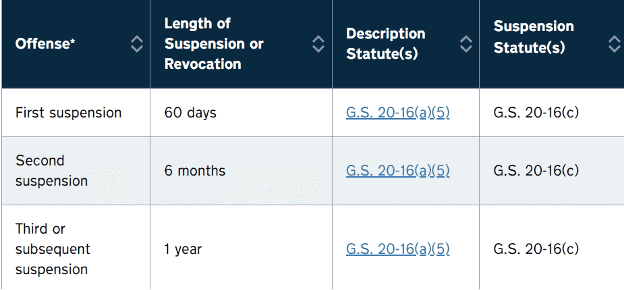
A driver's license will be suspended for the first time if they accumulate 12 or more points within three years. Following reinstatement, a subsequent suspension will occur if the driver accumulates 8 or more points in the next three years.
The following chart, provided by the North Carolina Department of Motor Vehicles (DMV), outlines the duration of each suspension period:
Besides that, some violations can lead to an immediate and complete loss of your driving privileges. These include:
- Intoxicated driving (DUI/DWI)
- Reckless driving
- Driving under suspension or revocation
- Hit and run
- Street racing
- Vehicular manslaughter or homicide
- Excessive speeding (often 30+ mph over the limit)
- Driving without a valid license
Knowing the regulations of your state will give ways of preventing a license loss and provide an answer to questions like how many tickets before a license suspension.
Can You Remove Tickets from Your Record?
Removing tickets is not a piece of cake, but one can achieve it in some cases. One may ask if it is possible to get rid of tickets on one's record.
The response is contingent upon your place of abode. Several states offer programs to help drivers clear minor traffic tickets from their records. Common examples include:
- California — Traffic school can mask certain tickets from your driving record.
- Texas — Defensive driving courses may dismiss minor violations.
- Florida — Some counties allow traffic school to prevent points on your license.
- New York — Pleading to a non-moving violation or completing a driver improvement course can help.
- Illinois — Traffic safety school may remove tickets from your record.
Each state has its own rules and eligible violations, usually for minor offenses like speeding or running a stop sign. The goal is to encourage safer driving without long-term penalties for small mistakes.
Once you have a confrontation with a ticket and come out victorious, your record will not reflect that. Ignoring tickets never does good, so always solve them as soon as possible.
Checking Tickets by License Plate or Number
Suppose you have misplaced your ticket and want to see if you have any pending fines. Many official websites allow you to check by license plate or driver's license number.
To look up tickets via license number, using these instruments is a perfect method. They serve as reminders of the tickets that you have not yet settled, and which, maybe, you have forgotten.
To check your tickets using your license number, here are reliable options:
- Your state’s DMV or Department of Motor Vehicles website
- Official state or local traffic court portals
- Trusted third-party services like TicketLookup.com or DrivingRecords.com (may require account setup)
These sites help you track unpaid or forgotten tickets securely. Setting up an account is usually necessary for privacy and protection, but it’s worth it to stay on top of your record.
The knowledge of outstanding tickets saves one from the embarrassment of bad credit or license suspensions.
How Traffic Tickets Work in Canada
Traffic tickets in Canada are handled by each province, and the rules can shift quite a bit depending on where you are. Most provinces run official websites where you can pay a ticket or dispute it online, which makes the whole system easier to navigate. In some places, completing a defensive driving course can even help reduce fines or remove points from your license.
Ignoring tickets is never a good idea. In Canada, unpaid violations can lead to a suspended license or even a deregistered vehicle, which turns a small problem into a major one. It is always smart to check your provincial government’s website so you know exactly what steps to take and how to avoid extra penalties.
Knowing how to fight a ticket can save you time, money, and stress. Each province has its own system, and understanding those details gives you a real advantage. Ontario is a good example. When you receive a ticket there, you can choose to pay it, try to negotiate a lower fine, or take the matter to court. You can also request disclosure, which gives you access to the officer’s notes and any evidence being used against you.
You May Also Like: Truck Driving Courses in Canada: How to Get Licensed in 2026
This information can uncover unclear signs, poor weather conditions, or weak details in the ticket that might help your case.
Tips for Fighting Tickets
Obtaining a traffic ticket is a painful experience, but do not let anxiety take control of you. Implementing the correct measures and being aware of your next step can really change the results.
Things to remember are: maintain your composure, focus on the facts, and take your steps without delay. Here are some effective strategies to combat your ticket and keep your driving record spotless.
- Verify your ticket thoroughly for errors like incorrect dates or wrong license plate numbers.
- Request the court to give you all the proof the officer relied upon, for example, radar calibration documents or photos.
- Collect your own evidence, for instance, video recordings or witness testimonies, which can confirm your version of events.
- Understand local traffic regulations to identify when an issued ticket is unjust.
- It is also worth considering a defensive driving program that may help in persuading the court to reduce points or dismiss the ticket.
- When you come before the court, be courteous and composed to create a positive impression of yourself to the judge.
- If it is relevant to your ticket, show that there were problems, such as poorly marked lanes or incorrect use of the radar device.
- Promptness is key because if you miss your deadlines, you can be faced with heavier fines or a license suspension.
- In case of serious tickets such as reckless driving, it is better to employ the services of an attorney who specializes in traffic laws.
- Keep tabs on your driving record as regularly as possible to be sure of spotting new tickets or infractions at an early stage.
The steps are quite simple, but they have a significant impact on the outcome of your case.
Don't wait until a ticket becomes an expensive issue. Start managing your driving record now by looking for any unpaid tickets and knowing what you can do.


