



The MCS-150 Update: What Every Trucking Company Should Do


Every trucking company needs a USDOT number. It is a unique identifier that the Department of Transportation uses to track a carrier’s safety record and key business information.
To keep that information current and your operating authority active, the FMCSA requires carriers to submit the MCS-150 update on a biennial basis.
We're going to dive into what's in the MCS-150, why it matters, how you submit it, and some easy ways to handle that every-other-year update.
Quick Summary:
- The MCS-150 biennial update is a mandatory FMCSA filing required every 24 months to keep USDOT registration active.
- All interstate carriers and certain intrastate operators must submit updated business and safety information, even if no changes occurred.
- The MCS-150 data feeds into the FMCSA CSA safety scoring system, which tracks seven core safety compliance categories.
- Filing requirements include carrier identification, fleet size, mileage, operation type, and insurance compliance details.
- Filing deadlines are based on the USDOT number, with the next-to-last digit determining the year and the last digit determining the month.
- Failure to submit the biennial update can lead to USDOT deactivation and civil penalties of up to $1,000 per day (up to $10,000 total).
What Is the MCS-150 Biennial Update?
The MCS-150 update is the formal document where carriers report any changes or confirm their USDOT number information every 24 months.
You May Also Like: The Difference Between DOT Number and MC Number
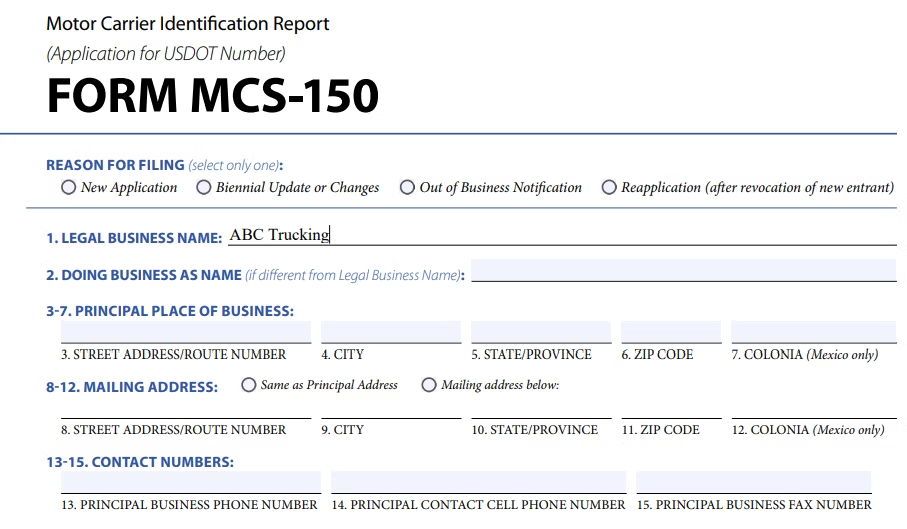
It applies to all interstate carriers and certain intrastate ones as mandated by federal regulations. Even if your business details haven’t changed, submitting the update is mandatory.
The number is a prerequisite to the maintenance of one’s operating authority and to the demonstration that federal safety requirements are observed. The Federal Motor Carrier bi-annual update is a call for the most proper reporting of your business activities to enable the FMCSA to assess safety and compliance.
Whenever you submit the MCS-150 form, the FMCSA goes through that data in conjunction with the data from accidents, roadside inspections, and investigations to figure out your safety score under the Compliance, Safety, Accountability program, called CSA.
The CSA program measures carrier safety performance by tracking seven major areas:
- Unsafe Driving – monitoring violations such as speeding, distracted driving, or recklessness
- Driver Fitness – verifying driver qualifications, for example, a valid CDL and medical certificates
- Hours-of-Service Compliance – making sure drivers are not allowed to go beyond the legal driving limits
- Vehicle Maintenance – the continuous check of the vehicle's service and repair routines
- Controlled Substances – assurance of adherence to the drug and alcohol testing requirements
- Crash Indicator – a collection of data on the carrier’s accident history
- Hazardous Materials Compliance – evaluation of hazmat carriers on training and proper documentation
On-time and precise biannual updates enable FMCSA to keep a close watch on your business and are a great way to make the roads safer for everyone. MCS-150 is essential if you want to stay clear of penalties and retain your license.
What Are the MCS-150 Biennial Update Requirements?
To fulfill the FMCSA’s requirements for the filing of the bi-annual update, carriers are obliged to reveal no less than basic details on their enterprise. Such data as:
- Legal business name
- USDOT number and MC number (if any)
- Total carrier mileage for the previous year
- Type of operation (interstate, intrastate, hazardous materials, or nonhazardous).
- Business role - whether you are a carrier, shipper, broker, or freight forwarder
- Number of vehicles and drivers the company has
- Insurance and safety compliance details
Following these requirements isn’t optional. The information you provide forms the backbone of FMCSA’s efforts to enforce safety regulations and, at the same time, acts as your essential pass to keep your operations running smoothly.
Detailed and accurate records will not only make your application for a biannual update a walk in the park but will also strengthen your organization.
How Do You Know When Your MCS-150 Update Is Due?
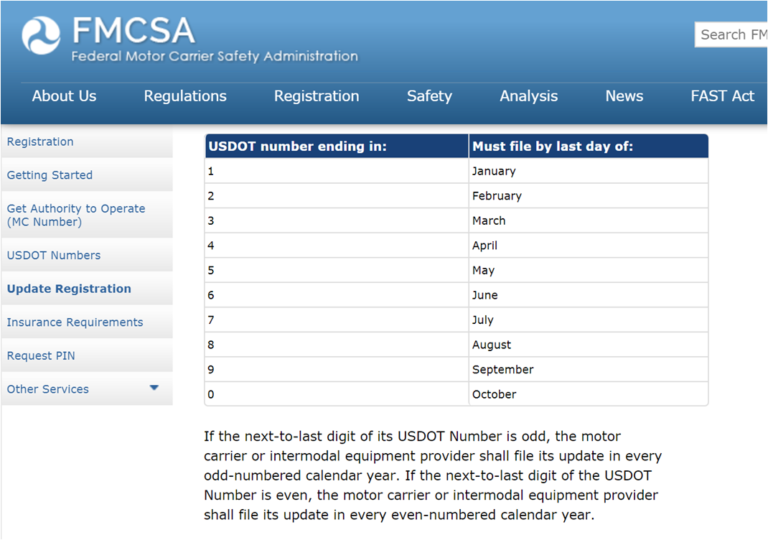
The date for the biannual update of each carrier is different and is determined according to the USDOT number. Below is the way to find out yours:
The next-to-last digit of your USDOT number is the indicator of the year when you are supposed to file. In case it is an odd number, then the filing should be done in odd years. Likewise, an even number means that filings are to be done in even years.
The last digit represents the month when your update is expected, from January to October. If your DOT number ends with a 5, your deadline would be the end of May.
You May Also Like: Another Round of ELD Removals: What Drivers and Fleets Must Do Now
You may as well submit your biannual update through the FMCSA portal, which is by far the best, quickest, and most secure way. Once done online, your DOT record is instantly updated, thereby allowing you to continue your operations without any break. It is also possible to file via mail or fax.
However, it may take up to six weeks before the request is processed, and there is a higher likelihood of mistakes.
What Happens If You Don't Update Your MCS-150?
In a situation where a trucking business went under, and the USDOT number was not properly deactivated, the FMCSA will assume that you are still in business.
As a result, you have to continue sending updates like the biennial MCS-150. Failure to complete a Biennial Update will result in the deactivation of your USDOT number and may result in civil penalties of up to $1,000 per day, not to exceed $10,000.
Keeping your DOT number open can also mislead brokers, shippers, insurers, and regulators, thereby damaging your brand and making it difficult for you to restart, sell your assets, or both.
Don’t let paperwork slow you down. File your USDOT biennial update today and stay on the road.
Frequently Asked Questions
What is the MCS-150 form?
The MCS-150 form is a mandatory report required by the Federal Motor Carrier Safety Administration that carriers use to update or confirm their USDOT registration information. It includes key business details such as fleet size, mileage, operation type, and safety-related data. This information is used by the FMCSA to maintain accurate records and support safety monitoring through its Compliance, Safety, Accountability system.
How often does the MCS-150 need to be updated?
The MCS-150 must be updated every 24 months, even if there have been no changes to the carrier’s information. This biennial requirement is based on the USDOT number, with deadlines determined by the last two digits of the DOT number. Missing the filing deadline can result in deactivation of the USDOT number and potential penalties.
How much does the MCS-150 update cost?
The MCS-150 biennial update is free when filed directly through the FMCSA. Carriers are not required to pay a government fee to submit the form online. However, third-party services may charge processing fees if they file on behalf of the carrier.
How do you complete the MCS-150 update online?
The MCS-150 update is completed through the FMCSA’s official online portal using the Unified Registration System. Carriers log in with their USDOT information, review existing company data, and submit any updates or confirmations. Once submitted, the system processes the information quickly and updates the USDOT record, helping ensure the carrier remains active and compliant without delays.


