



What’s the Best Truck Driving Job to Start Your Career?

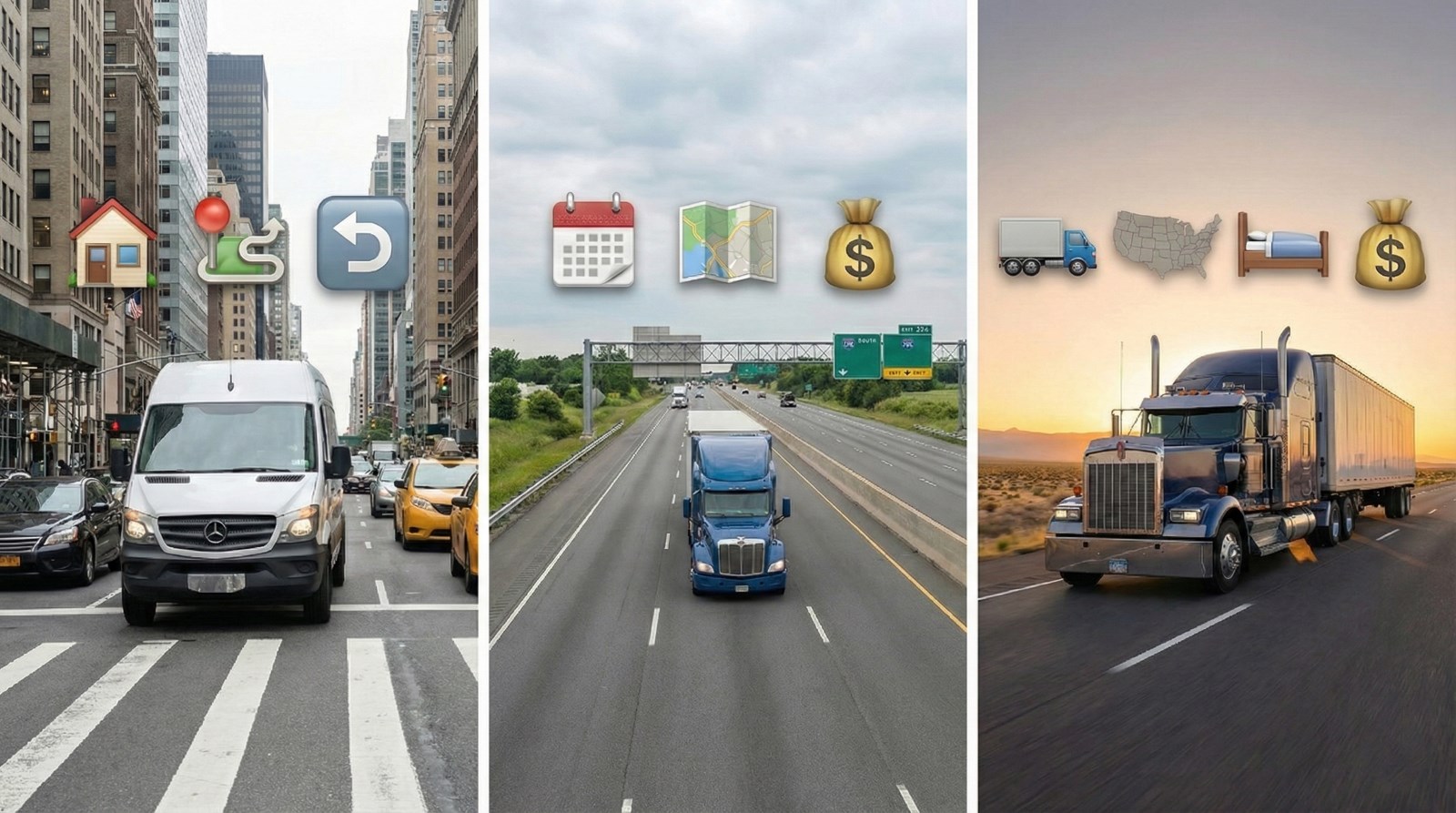
The best truck driving job to start your career is usually local or regional dry van trucking, since it offers the simplest freight, steady routes, and a smoother learning curve for new drivers. Starting out in trucking means choosing the right lane from day one, because that decision shapes your income, schedule, and how quickly you build real experience on the road.
From there, the real question becomes how to choose the type of trucking that actually fits your goals and lifestyle. Let’s break down the main options.
Key Facts:
- Local trucking typically involves same-day routes within a city or nearby area with daily home time for drivers.
- Regional trucking usually covers multiple states within a few hundred miles and often allows drivers to be home weekly.
- Over-the-road (OTR) trucking can require drivers to stay on the road for several weeks while traveling nationwide.
- Dry van trucking moves non-temperature-sensitive freight, while reefer trucking transports temperature-controlled goods like food and medicine.
- Specialized hauling includes flatbed, tanker, hazmat, and heavy haul operations that require additional skills and endorsements.
- Some non-CDL driving jobs exist, including local delivery, courier, yard driving, and light-duty transport roles.
Local Trucking
In case being with your family every night is the most important thing of all, then local trucking might be the right one for you. People working as local drivers are responsible for short-haul operations and thus can be seen stopping at places more frequently, as they are usually within the same city or nearby neighborhoods.
Delivery of goods to stores, warehouses, or construction sites is what you could be doing. Since the routes are short, you can see your family as often as you want, and at the same time, you will be saved from the loneliness that usually comes with long-haul life.
The disadvantage is that local trucking usually implies additional labor in the loading and unloading of the goods, and occasionally, you may be asked to assist in physically heavy tasks. The timetable can be very stressful, with very short delivery windows and a lot of traffic to be dealt with.
Anyway, if a job with regular working hours and the possibility of resting at home every night is what you are looking for, then local trucking is the right choice.
You May Also Like: Local vs. Long Haul Truck Driving: Which Career Fits You Best?
Many local drivers gradually develop a close relationship with the dispatchers and customers, which may lead to better routes and a more stable flow of work. It is also a good step to gain some experience before taking longer routes.
Regional Trucking
Regional trucking spans multiple states but keeps drivers quite close to their home base, usually within a few hundred miles. This alternative is ideal for those who want some life on the road but also some time at home. You may be away for two nights, but the weekend or certain days are kept for the family.
Regional routes usually cover more miles and have longer working hours than local jobs, hence the salary is raised most of the time. The routes may be a combination of highways and smaller roads. Thus, you will have the opportunity to improve your long-distance driving skills without the extreme schedule that comes with over-the-road trucking.
It is a goal for many drivers to switch from regional to over-the-road trucking by using the former as a stepping stone. Here they can gather experience, find out how to manage bigger rigs, and have comfort with overnight stays, whilst not being gone for several weeks.
Over-the-Road Trucking
If the thought of staying in a different town every few days is what makes you happy, then long-distance trucking is probably your thing. Such drivers travel to distant places, which can be from one coast to another, and along the way, they carry freight across the country. You will face numerous places, weather, and road conditions.
One's pay can go quite high, especially if one is willing to do a lot of miles, but it is a life that is being away from home for several weeks at a time that is asked in return. This lifestyle certainly isn't for everyone.
You have to be alright with spending your nights at truck stops or rest areas in Canada, managing meals while on the go, and handling the loneliness that sometimes accompanies life on the road.
You May Also Like: Where Do Truck Drivers Sleep? Top 5 Spots You Should Know
Still, the majority of them find a kind of freedom and a sense of independence in long-haul trucking, which other jobs just can't bring. The highest earning potential is also available for newer drivers who are willing to put in the miles.
Dry Van and Reefer
The biggest part of freight that is moved on the road is done with dry vans or enclosed trailers that carry non-perishable goods such as electronics, clothing, or household items. Dry van trucking is usually the first point of contact with the industry for a new driver, as the work is quite simple. You are to load and deliver without the need to look after any specific equipment or temperature control.
Meanwhile, reefer trucking includes moving the refrigerated trailers, which have been loaded with temperature-sensitive goods such as fresh fruits and vegetables, dairy, and medicines. The nature of the work demands that the driver pay extra attention because he/she has to ensure that the temperature stays at the set point throughout the trip.
Those drivers who like to have their hours stable but do not mind that at times the hours can be irregular would probably consider reefer jobs as a suitable option. The reefer cargo may become the reason for extra pay.
However, the hours may be less predictable and could thus include late-night or early-morning deliveries.
In case you are thinking which pays more, flatbed or reefer, the truth is that it depends on your region, experience, and the specific company. Both offer good pay, but the difference is that with reefers, there is the challenge of keeping perishable cargo safe while with flatbed hauling, one has to be skilled in securing the load.
Specialized Hauling
What you can do to raise your skills to a higher level is to opt for specialized hauling, where some of the best paychecks and challenges await you.
It is the area that involves flatbed loads, tankers that carry liquids or fuels, hazardous materials, and heavy haul that moves the oversize or overweight pieces of equipment or cargo.
Flatbed trucking requires being physically strong and detail-oriented. You will be doing the load securing by using chains, straps, and tarps, and at the same time, verifying that everything is safe to go. For the most part, a tanker driver is a person who must always be on the alert and strict with handling to avoid the occurrences of spills and ensure safety is maintained.
You want to know how to get car hauling contracts? That area gives you the freedom of choice and perhaps high earnings, but on the other hand, it needs you to be business-smart and have the right connections if you are to find a steady flow of work.
You May Also Like: Commercial Truck Insurance: Coverage, Cost, and Compliance
Specialized hauling is tough and daring. The risk level is higher, and so is the responsibility, but it comes with good pay because of the skill and the attention that is required.
Jobs Without a CDL
In case you are thinking, no-driver's license jobs exist, but the question is that do jobs exist without a CDL? The answer is yes. However, compared to full CDL jobs, the avenues are fewer. Such jobs usually comprise:
- Delivery Driver for Small Trucks or Vans – Local deliveries of lighter vehicles, most often within the city limits. Thus, parcel delivery or food distribution.
- Courier or Messenger Driver – Quickly delivering documents or small packages within a town.
- Yard or Terminal Driver – Relocating trailers in a freight yard or warehouse, typically on private property, and with small vehicles.
- Utility or Service Vehicle Driver – Operating vehicles which are used for maintenance, repairs, or landscaping.
- Tow Truck Driver (for light-duty vehicles) – Helping cars or small trucks that do not require a CDL to be moved.
- Bus Driver for Private or Shuttle Services – Local laws may exempt some smaller buses or shuttles from requiring a CDL.
- Apprentice or Trainee Driver – The role in which you assist or train under a fully licensed driver before getting your own CDL.
In addition to that, jobs with a CDL permit can be an entry point for people who are willing to start working in this field. The majority of companies are open to hiring drivers with a Commercial Learner's Permit (CLP)*.
A Commercial Learner’s Permit (CLP) is a temporary permit that allows a person to practice driving a commercial motor vehicle under supervision before obtaining a full Commercial Driver’s License (CDL), and it requires passing knowledge tests but not yet the full skills (road) test.
On the other hand, these positions are usually less paid and have fewer promotion possibilities as compared to full CDL jobs. Nevertheless, they are a great way to start your career and get some practical skills while on the job.
Getting the Right Company
After discovering the kind of trucking that best suits your personality, the next big step is to select the right company. This decision can greatly affect your trucking experience in a good or bad way. So it is worth taking the time to do some research.
1. Prioritize companies with thoroughly structured driver training and mentorship initiatives.
In 2025, the whole industry is focusing even more on safety and retaining staff. The best companies do not only give a quick CDL signing bonus and move on, but rather they invest in new drivers by providing them with quality orientation and continuous training.
If you have a good mentorship program, it means an experienced driver will be there to offer you guidance through the challenges that you will face in the real world, and not that you will have to figure out everything on your own.
2. Check the freight stability and equipment quality.
Steady freight is the main source of consistent paychecks. Do not get into business with those who have unstable freight or those who are heavily relying on brokers, because it usually means that you will have less control over your schedule and pay.
Equipment is also important. A well-maintained, up-to-date fleet lowers the chances of breaking down and getting into trouble. Inquire about the average truck age and what they use for tracking and communication.
3. Consider the company culture and support.
Are the dispatchers available and nice to you? Does the company listen to driver feedback, or does it treat you as just another number?
Websites like TruckersReport and forums are great places to find honest reviews. Also, social media groups for truckers in 2025 are full of driver experiences, so go there before committing and be a silent member for some time.
4. Don’t overlook the work-life balance they offer.
Some companies insist on maximum miles and long trips without being able to see your family. However, there are companies that realize drivers' needs for a regular schedule or at least that they are able to go home regularly.
Be honest during interviews about your home time requirements and see how the company reacts.
5. If you have a complicated background or previous issues, don’t panic.
The market is very competitive; however, still, a lot of companies are still willing to take such risks and provide jobs for high-risk drivers or those who have not had a perfect record, but show that they are responsible and have a good attitude. CR England, Maverick, and some regional carriers are the companies that are known for second-chance hiring programs.
6. Spotting the brands on the road helps too.
Companies with easily recognizable fleets, such as those famous trucking companies with blue trucks, are the ones that generally have the necessary resources to support their drivers well. Being able to offer more benefits and perks is what they usually do because they can afford to compete for the best talent.
After getting the necessary experience and endorsements, which will open the door to freight lanes that pay higher, numerous drivers set their sights on six-figure trucking jobs. Whether you want to be home every night, hit the road for a few days, or chase that long-haul life, there’s a spot for you.
Find your fit, pick the right company, and start driving toward a future that’s all your own.


