


 Blog
BlogDriving Tired vs Driving Drunk: Legal Risks, Statistics, and Real Cases for Truckers


If you’re a trucker, you know long hauls can wear you down. Driving sleepy and driving drunk might feel different, but both make it much harder to stay safe on the road. Your focus drops, your reactions slow, and your decisions get clouded. That is when crashes happened.
Fatigue creeps up quietly. You might not even notice it until your eyes start to wander and your hands slow down. Alcohol messes with your steering, braking, and judgment right away. Even one drink can push a commercial driver over the 0.04 percent BAC limit* and put you in serious legal trouble.
BAC limit it is the legal cutoff for how much alcohol can be in your bloodstream while driving.
Both fatigue and alcohol can sneak up on you, and both can ruin a run, your CDL, or someone’s life in an instant.
Key Facts:
- Commercial drivers in the U.S. are subject to a legal blood alcohol concentration (BAC) limit of 0.04% while operating a CMV.
- Research shows staying awake for 17–19 hours produces impairment comparable to a 0.05% BAC level.
- Being awake for approximately 24 hours can produce impairment comparable to a 0.10% BAC level.
- FMCSA Hours-of-Service (HOS) rules limit driving time and require mandatory rest breaks for commercial drivers.
- NHTSA identifies drowsy driving as a factor that significantly slows reaction time and reduces decision-making ability.
Physiological Effects of Driving While Drowsy vs Drunk
Feeling tired after a long haul is normal. Long hours, monotony, and driving at unusual times all take a mental toll. Some of the main reasons long drives make you tired include:
- Circadian rhythm disruption: Driving during natural sleep hours reduces alertness.
- Mental strain: Continuous attention to traffic, mirrors, and road conditions is exhausting.
- Limited breaks: Short or irregular breaks prevent recovery.
Research shows that being awake for 17 to 19 hours is similar to having a 0.05% BAC. Being awake for 24 hours is roughly equivalent to a 0.10% BAC, which is legally drunk. The danger is that fatigue feels normal in trucking. Alcohol does not. The difference is you may not notice fatigue creeping in, while alcohol effects are usually more obvious.
To better understand the risks, here is how fatigue compares to alcohol impairment.
What’s the Difference Between Tired and Drunk Driving?
Legal Implications: Driving While Fatigued vs Drunk
The law treats fatigue and alcohol differently. Both carry serious consequences, but enforcement works in different ways.
- Drunk driving:
Commercial drivers cannot operate a CMV with a BAC of 0.04 or higher. Violations lead to immediate removal from duty, CDL disqualification, return-to-duty evaluations, and possible criminal charges, including DUI or vehicular manslaughter.
- Fatigue / sleepy driving:
Hours-of-Service rules regulate maximum driving hours and required rest periods. Violating HOS is a regulatory offense, but it can become criminal if fatigue leads to a crash. Evidence includes ELD logs, dispatch records, GPS or cell data, and driver statements.
Alcohol violations are easier to measure and prosecute. Fatigue violations rely on patterns of negligence and documented proof. Both types of violations can result in civil and criminal liability.
Real 2025 Cases Highlighting the Risk
Seeing real-world examples shows how fatigue and alcohol impairment can lead to accidents and legal consequences. These incidents also show how physiological impairment translates directly into legal consequences:
1. Fatigue-related crash: Terrell, Texas, June 28, 2025
- A tractor-trailer driver reportedly fell asleep on I‑20, causing five fatalities and seven injuries. Investigators noted the driver had exceeded HOS limits and failed to take adequate breaks on a long-haul route.
- ELD logs and dispatch records were crucial in proving HOS violations and supporting criminal charges of vehicular manslaughter and aggravated assault.
This case highlights how physiological fatigue (slowed reaction times, microsleeps) can turn into legal liability when ignored or improperly managed.
2. Drunk-driving crash: California, Nov 22, 2025
- A CMV driver swerved on I‑5 with a BAC of 0.275%, over six times the legal CMV limit. Video evidence showed unsafe lane departures, leading to immediate arrest and criminal prosecution.
- The truck carried hazardous cargo, increasing both the legal stakes and potential civil liability for the driver and carrier.
Unlike fatigue, alcohol impairment is immediately measurable, which makes enforcement straightforward, but the consequences mirror those for fatigue-related crashes: death, injuries, and criminal charges.
FMCSA Update 2026
To put these risks in a regulatory context, the FMCSA’s recent actions show how law and safety rules interact with driver behavior:
- In February 2026, FMCSA extended a winter-weather HOS waiver across 40 states, temporarily relaxing driving-hour limits for emergency response.
- Even during emergencies, drivers must remain vigilant. Waivers help meet operational demands, but don’t remove the physiological risks of long hours. Fatigue is still real and dangerous.
👉 The waiver does NOT relax BAC rules. Drivers remain strictly limited to 0.04% BAC for CMVs. This emphasizes that while regulators can adjust hours for safety or emergencies, alcohol impairment is non-negotiable.
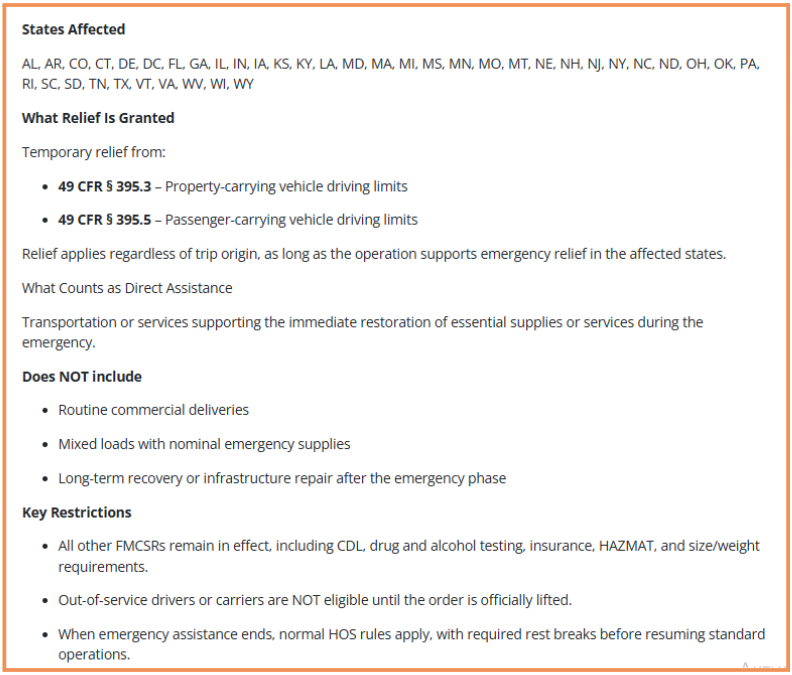
FMCSA updates show the balance between operational flexibility and maintaining legal safety standards. Truckers must manage fatigue proactively even when regulations temporarily allow extended hours.
Long-Distance Driving and Fatigue Prevention
Long-distance trucking shows how physiology, legal risk, and accident risk are connected. Understanding why fatigue happens is key:
- Monotony, mental strain, circadian disruptions, limited breaks, and cumulative sleep debt all reduce alertness.
- Ignoring fatigue or skipping breaks can lead to HOS violations. In the event of a crash, ELD data and driver records are scrutinized, similar to BAC evidence in drunk-driving cases.
- Excessive driving without rest, like in the Terrell crash, can have catastrophic outcomes. Proving fatigue may be more complex than alcohol impairment, but the consequences can be just as severe.
Treating fatigue with the same seriousness as alcohol impairment protects both safety and your career. Safe driving depends on following the rules and listening to your body.
Take care!


