



78 Drivers Out of Service: What Happened During Operation Saturday Night Fever?

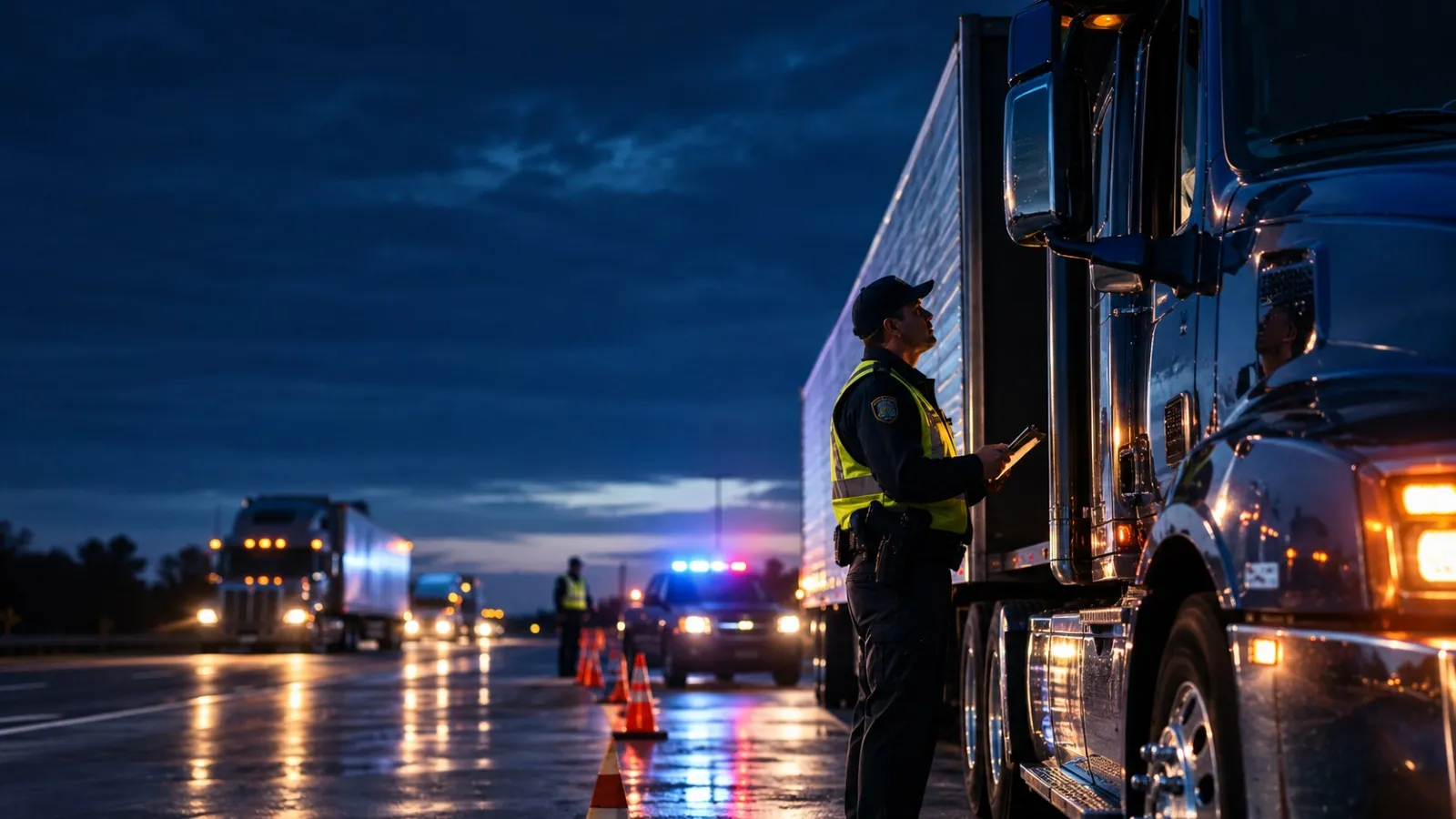
On September 26, 2026, federal and state agencies conducted an overnight commercial vehicle enforcement operation across South Carolina, North Carolina, Georgia, and Florida. Called Operation Saturday Night Fever, the operation focused on commercial vehicle safety and driver compliance along major freight corridors.
According to FMCSA, the operation resulted in 552 inspections, 78 drivers and 25 vehicles placed out of service, including 12 drivers cited for English Language Proficiency violations. The South Carolina Department of Public Safety reported 568 inspections, 173 moving violations, and seven criminal arrests.
The numbers show the scale of the operation, but what was actually checked during these inspections, and what does it mean for truck drivers, dispatchers, and fleet managers?
Key Facts:
- Operation Saturday Night Fever took place on September 26, 2026, across four states: South Carolina, North Carolina, Georgia, and Florida.
- FMCSA reported 552 inspections, while the South Carolina Department of Public Safety reported 568.
- A total of 78 drivers were placed out of service, including 12 for English Language Proficiency violations.
- Inspectors placed 25 commercial vehicles out of service during the operation.
- South Carolina DPS reported 173 moving violations and seven criminal arrests.
What Was Operation Saturday Night Fever?
Operation Saturday Night Fever was a coordinated, overnight commercial motor vehicle enforcement initiative conducted on Saturday, September 26.
FMCSA says the operation focused on improving roadway safety and addressing criminal activity along major freight corridors. Federal safety investigators worked with the Department of Homeland Security and state police to conduct commercial vehicle inspections and examine driver and vehicle compliance. The South Carolina Department of Public Safety describes the operation as a periodic nighttime enforcement initiative aimed at identifying unsafe commercial motor vehicles and drivers during late-night and early-morning hours.
It was the third Operation Saturday Night Fever conducted by South Carolina State Transport Police in 2026 and the first to expand beyond South Carolina through coordination with FMCSA and law enforcement partners in North Carolina, Georgia, and Florida.
Where Did the Operation Take Place?
The operation covered four Southeastern states:
- South Carolina
- North Carolina
- Georgia
- Florida
The South Carolina release says the coordinated effort covered the I-95 corridor, with the North Carolina State Highway Patrol, Georgia Department of Public Safety, and Florida Highway Patrol conducting enforcement activities simultaneously across their states.
According to South Carolina DPS, 70 State Transport Police officers were deployed across South Carolina's interstate system during the operation.
What Were the Results of the Operation?
The official agencies reported slightly different totals for inspections. FMCSA reported 552 inspections, while the South Carolina Department of Public Safety reported 568 commercial motor vehicle inspections. Both agencies reported the same numbers for drivers and vehicles placed out of service.
The South Carolina Department of Public Safety reports 173 moving violations and seven criminal arrests. This is 16 more inspections than the 552 reported by FMCSA, and neither agency explains the discrepancy. The seven arrests included cases involving driving under suspension, fentanyl trafficking, and possession of drugs or controlled substances.
What Did Inspectors Check During the Operation?
The inspections addressed both driver and vehicle safety. FMCSA says investigators verified driver credentials, checked for fatigue, evaluated electronic logging devices, looked for distracted driving and unsecured cargo, and assessed English Language Proficiency.
The South Carolina Department of Public Safety adds that officers also looked for ELD manipulation, mechanical deficiencies, impaired driving, and other violations. These additional checks show that enforcement extended beyond paperwork and driver credentials to include vehicle condition, electronic records, and driving behavior.
Why Was the Operation Conducted at Night?
South Carolina officials described Operation Saturday Night Fever as a periodic nighttime enforcement effort focused on late-night and early-morning hours and high-crash corridors. The nighttime operation also involved simultaneous enforcement activities in four states. South Carolina State Transport Police worked alongside partner agencies in North Carolina, Georgia, and Florida as part of the coordinated effort.
What Does the Operation Mean for Truck Drivers?
For drivers, the operation is a reminder that routine trip preparation includes more than choosing a route and estimating arrival time. Drivers need to have the required credentials and records available and operate the vehicle in compliance with applicable safety requirements.
The operation should not be interpreted as a new nationwide inspection requirement. It was a specific four-state enforcement initiative conducted on September 26, and FMCSA's release does not state that Operation Saturday Night Fever creates a new inspection requirement for all commercial drivers across the country.
What Should Dispatchers and Fleet Managers Take From the Operation?
For dispatchers and fleet managers, the practical takeaway is the importance of having accurate trip information before a driver gets on the road. A route may include multiple states, freight corridors, fuel stops, parking areas, repair facilities, and other truck-service points. Having this information available can help dispatchers organize the trip and account for planned stops and services along the route.
The best route-planning tools do not determine whether a driver will be inspected. Enforcement decisions are made by the relevant authorities, and drivers must follow roadside signs, official instructions, and applicable regulations.
How Can Trucker Guide Help With Route Planning?
Trucker Guide is designed for truck-specific navigation and route planning. Its map and business information can help drivers and dispatchers identify truck-related services and points of interest along a trip. The platform includes 450,000+ truck-related places and services, along with truck-specific routing to identify restrictions such as low clearances, no-truck zones, and weight limits.
For a dispatcher planning a route through multiple states, a practical workflow can look like this:
1. Build the planned truck route.
2. Check fuel, parking, repair, and other truck services along the route.
3. Review traffic and road information available on the map.
4. Share relevant route-planning information with the driver.
Trucker Guide can serve as a planning resource alongside driver and fleet safety procedures. It is not an enforcement or inspection-avoidance tool, and its information does not replace roadside signs, official instructions, or applicable state and federal requirements.
Does Operation Saturday Night Fever Mean More Inspections Are Coming Nationwide?
There is not enough information in the FMCSA release to say that more inspections are coming nationwide.
FMCSA announced the September 26 operation as a coordinated enforcement effort involving four states. The agency did not say that the operation is part of a nationwide inspection schedule or that similar operations will take place in every state. For now, Operation Saturday Night Fever is best understood as a documented example of coordinated commercial vehicle enforcement, rather than an announcement of a new nationwide inspection program.
For drivers, that means the operation should be viewed as a targeted enforcement effort, not a signal that nationwide inspections are coming.
Frequently Asked Questions
What is Operation Saturday Night Fever?
Operation Saturday Night Fever was a coordinated overnight commercial motor vehicle enforcement operation conducted on September 26, 2026, across South Carolina, North Carolina, Georgia, and Florida. FMCSA participated with federal and state law enforcement agencies.
How many truck inspections were conducted?
FMCSA reported 552 inspections. The South Carolina Department of Public Safety reported 568 inspections across the four participating states. Because the official releases give different totals, both figures should be attributed to their respective sources.
How many drivers were placed out of service?
78 drivers were placed out of service during the operation. Twelve of those drivers were placed out of service for English Language Proficiency violations.
How many vehicles were placed out of service?
25 vehicles were placed out of service, according to both FMCSA and the South Carolina Department of Public Safety.
How many moving violations were issued?
The South Carolina Department of Public Safety reported 173 moving violations during the four-state operation.
Were there criminal arrests?
Yes. South Carolina DPS reported seven criminal arrests, including cases involving driving under suspension, fentanyl trafficking, and possession of drugs or controlled substances.
Can Trucker Guide help drivers avoid inspections?
No. Trucker Guide is a navigation and truck-service information platform, not an inspection-avoidance or enforcement tool. Drivers should follow official roadside signs, instructions from enforcement personnel, and all applicable federal and state requirements.


