



Parking a Semi in a Residential Zone? Learn the Regulations First


There is no single nationwide rule for this because parking a semi-truck in a residential area is mainly controlled by local city or county ordinances, not federal or state law. In practice, it becomes a mix of zoning rules, traffic safety concerns, and neighborhood restrictions that differ from place to place.
As of 2026, enforcement is stricter in many urban areas, while the ongoing shortage of legal truck parking still leaves some drivers with very limited options near home. That is why the outcome always depends on the exact location, local rules, and whether designated truck parking is available nearby.
Key Facts:
- There is no nationwide U.S. law regulating semi-truck parking in residential zones; rules are set locally
- Many cities restrict large commercial vehicles based on size, weight, or length (commonly 20–26 feet or 26,000+ lbs GVWR thresholds)
- Common enforcement models include full bans, short time limits (24–72 hours), or permit-based parking systems
- Typical fines range from $50 to $500 depending on the city and violation severity
- Towing costs can exceed $1,000 in many metro areas
- Repeat violations may result in additional penalties and, in some cases, CDL-related consequences
- Rural areas remain significantly more flexible compared to dense urban regions
Why are Semi-Trucks a Concern in Residential Areas?
When a semi-truck shows up in a residential neighborhood, it’s not just about parking space. It changes how the whole street feels and functions, which is why most cities regulate it so closely in 2026.
1. Safety risks
A fully loaded semi-truck can weigh up to 80,000 pounds. In residential streets with limited visibility, narrow roads, and pedestrian activity, large vehicles can create blind spots, restrict emergency access, and increase accident risk.
2. Noise impact
Diesel engines, air brakes, cooling systems, and idling all contribute to noise pollution. Even when parked, refrigeration units or idle engines can disturb nearby residents, especially overnight.
3. Traffic obstruction
Residential streets are not designed for large commercial vehicles. A parked semi can block driveways, reduce lane space, and make navigation difficult for emergency and service vehicles.
4. Neighborhood zoning standards
Many communities maintain “residential character” rules designed to limit commercial activity in living zones. Large trucks are often viewed as incompatible with these standards.
5. Environmental concerns
Idling trucks contribute to localized emissions, which cities are increasingly regulating through anti-idling and air quality rules.
The frustrations caused by illegal semi-truck parking in residential areas are not just theoretical - they’re real. In the video below, hear directly from neighbors who are fed up with the challenges posed by semi-trucks parked illegally in their communities. They share personal stories about how these vehicles disrupt their daily lives, from blocking streets and creating safety hazards to generating unbearable noise and pollution.
You May Also Like: Know Your Limits: Speed Rules on USA Highways and Interstates
While the video highlights the very real frustrations faced by residents, it also underscores the urgent need for effective solutions. To address these concerns, cities and towns across the U.S. have implemented specific neighborhood regulations for semi-truck parking.
What are the Residential Parking Regulations for Semi-Trucks?
The rules about parking semi-trucks in residential areas vary widely depending on where you are. Some places are strict, while others are more flexible. Here’s how it generally breaks down:
1. No Parking Allowed
In some cities, parking a semi-truck in a residential area is strictly off the table. For instance, in Los Angeles, local laws prohibit parking any vehicle over 22 feet long on residential streets unless you’ve secured a special permit.
Basically, NYC doesn't allow commercial vehicles to block roads or hog public parking spots for too long. These rules aim to maintain safe and organized neighborhoods. Ensure you comply with these regulations to avoid penalties if you park in these areas.
2. Time-Limited Parking
Other areas allow short-term parking but set time limits to keep things moving. In Houston, Texas, you can park a semi-truck on a residential street, but only for up to 72 hours. After that, you’re risking a fine.
In Chicago, overnight truck parking is allowed if the truck is actively delivering goods, but it has to leave within a specific time-frame.
3. Conditional Permits
Some places offer permits that let residents park semi-trucks at home under certain conditions. For example, you might need to prove you live at the address or agree to limit how often the truck is parked there.
To figure out the rules in your area, check with your local Department of Transportation (DOT), municipal planning office, or neighborhood association. Every city and town has its take on zoning for truck parking, so it’s worth doing your homework.
How Do Truck Parking Restrictions Differ Across the U.S.?
Each state has its own approach to regulating commercial vehicle parking, particularly in residential zones. These rules often reflect the unique needs of urban centers versus rural communities, as well as environmental concerns, traffic patterns, and local priorities.
Here’s a look at how some states handle truck parking regulations in 2026.
California
California is still one of the strictest states in 2026. In most big cities, semi-trucks or large commercial vehicles can’t just park on residential streets overnight.
Places like Los Angeles and San Francisco usually limit parking based on vehicle size, often around the 20–24 foot range, and require permits for anything longer or heavier. If you break the rules, fines usually land somewhere between $100 and $500, and towing can easily push past $1,000. On top of that, anti-idling rules are heavily enforced in many metro areas, with extra fines that can exceed $250.
Texas
Texas is much more relaxed, especially outside major cities. In rural areas, you’ll often find no real restrictions on parking a semi at home. In cities like Houston, Dallas, and Austin, though, there are usually time limits. Most areas allow parking for about 48 to 72 hours before it becomes a violation. Fines are usually moderate, around $75 to $300 depending on the city. Enforcement is also more complaint-based than routine.
Florida
Florida is a mix of strict coastal rules and more relaxed inland areas. In cities like Miami, Fort Lauderdale, and Tampa, residential truck parking is usually limited or banned for vehicles over roughly 20–26 feet unless you’re actively loading or unloading. Some areas only allow very short stops, sometimes just 24 hours or less. Fines typically start around $50 to $150, but repeat violations can climb quickly.
In inland parts of Florida, enforcement tends to be lighter, and longer parking is sometimes tolerated depending on the neighborhood.
Illinois
Illinois sits somewhere in the middle, but Chicago pulls the state toward stricter enforcement. In and around Chicago, residential parking for large commercial vehicles is usually limited by weight rules around 8,000 to 10,000 pounds GVWR, with time limits often between 12 and 24 hours in suburbs. Fines usually range from $150 to $500, and towing is common.
Outside major cities, especially in farming regions, the rules are more relaxed and enforcement is lighter.
Pennsylvania
Pennsylvania is strict in cities but more flexible outside them. In Philadelphia and Pittsburgh, semi-trucks generally can’t stay parked in residential areas unless they’re actively making a delivery. Even then, it’s usually limited to short windows like 24 hours or less. Fines are commonly around $100 to $300.
Smaller towns and rural areas are more lenient, especially where trucking activity is part of daily local life.
New York
New York is one of the toughest states for residential truck parking in cities. In New York City, trucks over about 20 feet usually can’t park overnight on residential streets at all. Enforcement is fast, and towing can happen quickly once a violation is flagged. Fines often fall between $150 and $300.
Upstate New York is more forgiving, with many suburbs allowing 24 to 72 hour parking windows depending on local rules. Anti-idling fines can still exceed $250 statewide.
Ohio
Ohio is fairly balanced. In Columbus, semi-trucks can often park in residential areas for up to about 48 hours. In Cleveland and nearby suburbs, it’s usually closer to 24 hours. Fines are generally modest, around $50 to $250 depending on the city.
Outside the cities, especially in rural Ohio, enforcement is light and rules are more flexible.
Michigan
Michigan rules really depend on the city. In Detroit, residential truck parking is often limited to about 48 to 72 hours. In places like Ann Arbor, it’s usually not allowed at all. Rural and northern areas are much more relaxed.
Winter also plays a role here, since snow removal rules can temporarily restrict street parking. Fines typically range from $100 to $400.
Georgia
Georgia keeps a balance between control and flexibility. In the Atlanta metro area, residential truck parking is usually limited to about 24 to 72 hours, and heavier vehicles (around 26,000 lbs GVWR and up) face stricter enforcement. Deliveries are usually allowed but must happen within set hours.
Outside the city, especially in rural counties, rules are much looser. Fines generally range from $75 to $250.
Washington
Washington is strict in cities and much more relaxed outside them.
In Seattle, residential parking for large trucks is heavily restricted, usually for anything over 20–22 feet unless you’re actively working. Anti-idling enforcement is also strong, with fines that can reach $250 to $500. In eastern Washington, rules are far more relaxed, and longer parking is often allowed depending on local zoning.
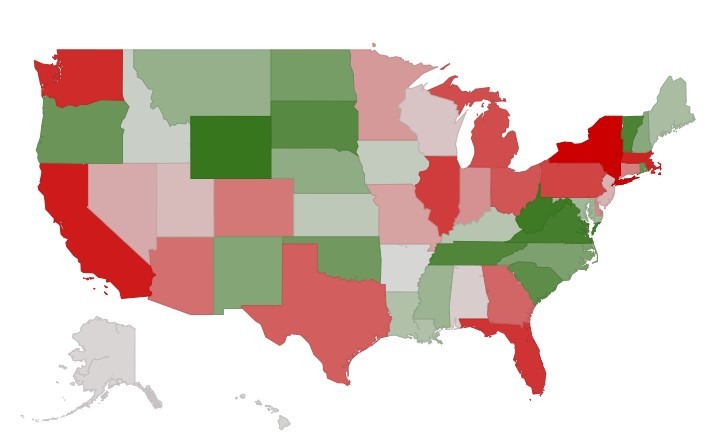
To gain a visual insight into these regulations, take a look at the chart below. It maps out the level of restrictiveness for truck parking across all U.S. states, color-coded for clarity:
- Red: States with the highest restrictions, such as California, New York, and Washington, where urban areas impose strict bans on large trucks in residential zones.
- Grey: States with moderate restrictions, such as Alaska, Iowa, and Hawaii, where urban areas enforce time limits or size restrictions but rural areas are more lenient.
- Green: States with the lowest restrictions, such as West Virginia (WV), Wyoming, and the District of Columbia (DC), where rural areas are largely unrestricted, and even urban areas have relatively lenient rules.
You May Also Like: How Much Do Truck Drivers Earn in Different States?
Understanding these variations is essential because failing to comply with local regulations can lead to serious consequences.
What Happens If You Break the Rules?
Parking a semi-truck in a restricted residential area might seem like a small thing at first, but in 2026 it can get expensive fast.
Most cities treat it as a zoning or traffic violation, and the first thing you’ll usually see is a ticket. Depending on the location, fines typically start around $50 to $100 for a first offense. In stricter urban areas, that can quickly jump to $200–$500, especially if the truck is oversized or clearly violating a posted restriction.
If the vehicle stays parked beyond the allowed time, towing becomes the next step. And that’s where costs really spike. Between towing, storage fees, and release charges, drivers often end up paying well over $1,000 just to get the truck back. In major metro areas, that total can climb even higher if the truck sits in impound for multiple days.
Repeat violations are where things start to affect your career, not just your wallet. Some municipalities can escalate penalties for repeated offenses, and in certain cases, violations tied to unsafe parking, obstruction, or repeated zoning breaches can be reported in ways that indirectly affect CDL records or employer compliance reviews. Even when it doesn’t hit your license directly, it can still create issues with carriers who track safety and compliance history closely.
There’s also the legal side that drivers often don’t think about. If a parked semi blocks visibility, limits emergency access, or leads to a complaint from residents, it can trigger formal citations or even court appearances in more serious cases. For fleets, repeated violations can also become a reputational problem, especially when operating in tightly regulated urban markets.
The bottom line is simple: what looks like “just parking at home for a night” can turn into fines, towing bills, and compliance headaches that cost far more than a truck stop or legal parking spot ever would.
How Can Truck Drivers Navigate Residential Parking Challenges?
If you’re a truck driver or fleet manager trying to figure out where to park, here are some practical tips to keep you on the right side of the law:
- Before heading to a new location, research the truck parking regulations in that area. State Department of Transportation websites can be a reliable source for updated rules, restrictions, and designated parking zones.
On major freight corridors, planning gets a bit easier because rest infrastructure is more predictable. Along Interstates like I-22, I-30, I-39, I-66, and I-76, truckers will usually find a mix of official rest areas and commercial truck stops spaced at regular driving intervals. However, availability is not always guaranteed, especially near busy metro zones or during peak freight hours, so it’s still important to plan ahead instead of relying on the next exit.
- Look for nearby truck stops, rest areas, or private lots designed to accommodate large vehicles. Some businesses even rent out parking spaces specifically for semi-trucks.
- If you own a semi-truck and live in a residential area, let your neighbors know what’s going on. A little communication can go a long way toward avoiding complaints.
- If your area offers conditional permits for residential parking, jump through the hoops to get one. Just make sure you follow all the rules that come with it.
- GPS truck navigation systems tailored for truckers can help you find approved parking spots and steer clear of restricted zones.
Residential areas can pose challenges when it comes to parking a semi-truck. Between semi-truck parking laws, zoning for truck parking, and community concerns, there’s a lot to consider. While some areas are more accommodating than others, understanding and following the rules is key to avoiding fines, towing fees, or angry neighbors.
So, before you park that semi-truck in a residential area, take a minute to check the rules on parking trucks in residential areas.
Frequently Asked Questions
Can you park a semi-truck in a residential area?
It depends entirely on local city or municipal rules, not a single nationwide law. Many residential areas restrict or ban semi-truck parking due to size, noise, and safety concerns, while rural zones are often more flexible. Always check local ordinances before parking, as violations can result in fines or towing.
Can I park my commercial truck at home or in my driveway?
In some areas, yes, but only if local zoning laws allow it or you have a special permit. Many cities restrict commercial vehicles in residential driveways, especially if the truck exceeds certain size or weight limits. Home parking is more commonly allowed in rural or agricultural regions.
Are semi-trucks allowed to drive on residential streets?
Yes, semi-trucks can legally drive on residential streets when making deliveries or accessing approved routes. However, they are usually restricted from long-term parking in those areas. Some cities also limit truck size or require designated truck routes for non-local traffic.
Can you park a box truck in a residential area?
Box trucks are often treated more leniently than full semi-trucks, but rules still vary by location. Many cities allow short-term parking for loading or unloading, while longer stays or overnight parking may be restricted. Local size limits and zoning rules determine what is permitted.
Where can I park my semi-truck overnight?
Semi-trucks are typically parked overnight at designated truck stops, highway rest areas, commercial parking lots, or approved fleet yards. Some rural areas may allow residential or roadside parking, but this is not guaranteed and depends on local enforcement rules.
What zoning is required for semi-truck parking?
Semi-truck parking is usually restricted in residential zoning districts and allowed in commercial, industrial, or transportation-related zones. Some municipalities may issue conditional permits for residential parking, but these are limited and subject to strict rules.
What is the largest vehicle you can park on a residential street?
The allowed vehicle size varies by city, but many urban areas restrict vehicles longer than 20–26 feet or over a certain weight (often around 10,000–26,000 lbs GVWR). Larger commercial vehicles like semi-trucks are frequently prohibited unless special permission is granted. Always check local regulations, as limits differ significantly by location.


