


TRACTION
TIRES
ADVISED
Traction Tires Advised
Oversize loads are prohibited from the roadway under this advisory.


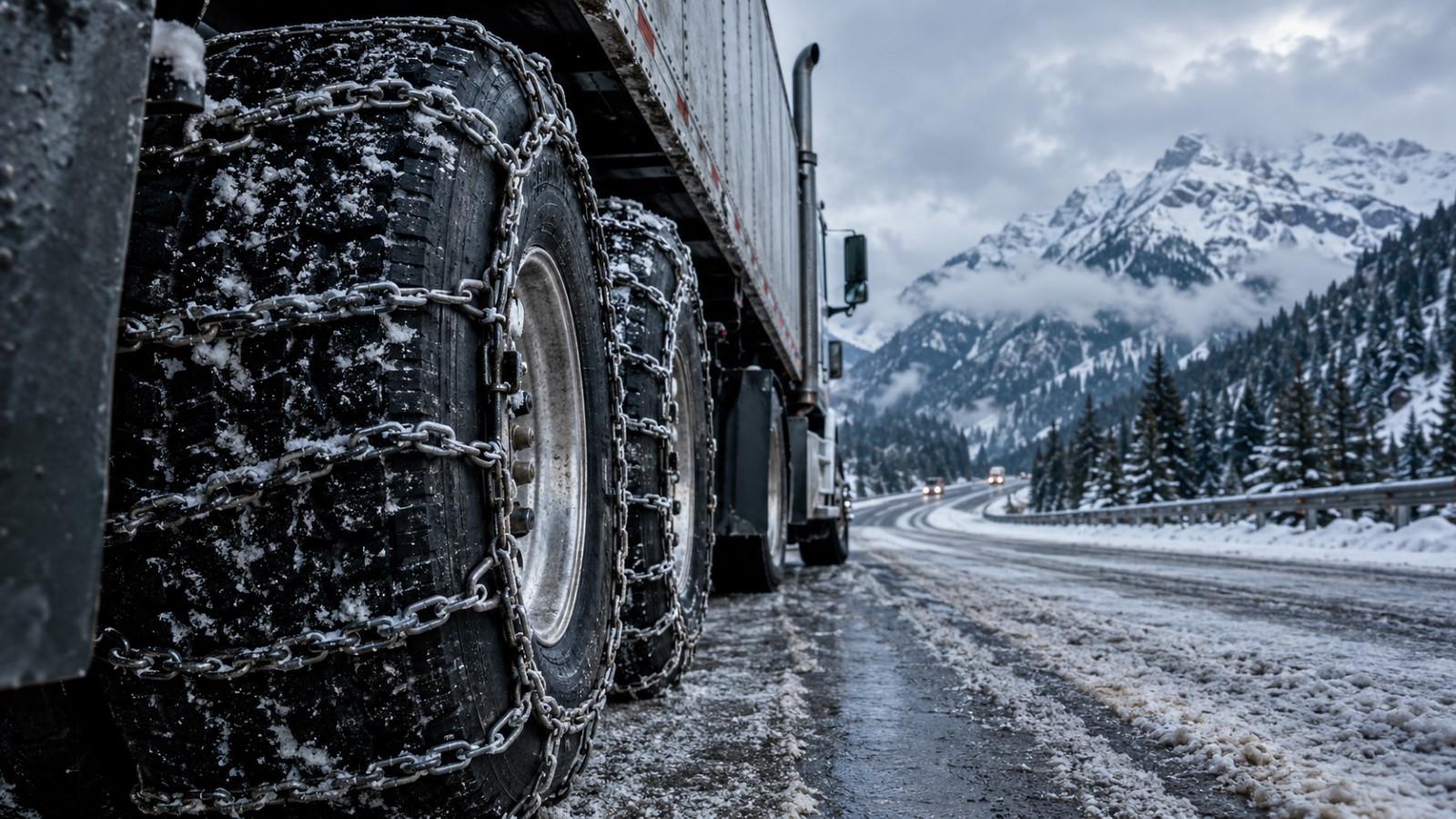
Washington’s 2026–2027 winter chain requirements set out what commercial truck drivers must carry, when chains must be installed, and how they must be positioned for different vehicle configurations.
Here is what truck drivers need to know before heading into Washington's mountain routes this winter.
From November 1 through April 1, vehicles and combinations of vehicles weighing more than 10,000 pounds must carry sufficient tire chains on 12 designated highway sections, regardless of current weather or whether a chain-up advisory is posted. From April 2 through October 31, chains must be carried on these routes when specifically required by posted signs.
The seasonal requirement applies to designated sections of these highways:
Drivers should check the official WSDOT commercial vehicle chain requirements for the exact route limits and mileposts. There is a limited exception for local deliveries: vehicles operating outside chain-required areas and not crossing a mountain pass may be exempt. Drivers should confirm that their route and delivery qualify before relying on this exception.
Carrying chains does not automatically mean they must be installed at all times. The next step is to understand the posted controls and what they require.
WSDOT uses posted traction and chain controls to tell drivers what equipment is required as conditions change. For commercial vehicles over 10,000 pounds, the distinction between a traction advisory and a chain requirement matters.
Do not assume that traction tires, four-wheel drive, or all-wheel drive exempt a commercial vehicle from a chain requirement. Studded tires do not replace chains when chains are required.
Failure to install chains when required can result in a $500 fine. WSDOT or Washington State Patrol may also prevent inadequately equipped vehicles from entering a chain-control area. Once drivers understand the posted controls, they need to make sure their chains meet Washington's equipment specifications.
Washington requires approved chains for vehicles over 10,000 pounds to meet specific construction standards. Under WAC 204-24-050*, chains must have at least two side chains connected by sufficient hardened-metal cross chains to keep at least one cross chain in contact with the road surface at all times.
Plastic chains are not permitted under this commercial specification. Cable chains may be allowed, and the Washington State Patrol may approve equivalent traction devices.
Drivers must also carry at least two extra chains during the seasonal carry period. This requirement applies even when no chain-up advisory is active. Spare chains are needed if a chain breaks, becomes unusable, or road conditions require additional chains. Automatic tire-chain systems do not replace this requirement. Vehicles equipped with these systems must carry regular chains for the outside tires of the drive axles fitted with the automatic system.
Before winter travel, drivers should inspect their chains for damage, confirm that they fit the tires, and make sure they can install them safely. Having the right equipment in the truck is only the first step, as it must also be placed correctly.
WAC 204-24-050 is a Washington State regulation that defines tire-chain and traction-device requirements for vehicles, including commercial trucks, during winter driving conditions. It specifies chain placement for different axle configurations, spare-chain requirements, and rules for designated routes where trucks must carry chains.
Washington does not use one universal chain-placement pattern for every truck. The required arrangement depends on the number of axles, drive-axle configuration, trailer setup, and posted control.
WSDOT's official commercial vehicle chain-placement diagrams show the required positions for different combinations. It covers:
- Two- to four-axle vehicles and combinations. Chain placement depends on the drive axle and whether a trailer is attached. Some configurations also require chains on a trailer axle.
- Five-axle combinations. Requirements differ for single-drive-axle and dual-drive-axle tractors. The applicable arrangement may include chains on the drive axle and the last trailer axle.
- Six-or-more-axle combinations. The required placement can include all tires on a drive axle and tires on specified trailer axles. More restrictive controls can require additional drive-axle tires to be chained.
- Super-single configurations. Specific placement rules apply, so drivers should use the diagrams for their exact equipment rather than applying standard dual-tire instructions.

These are broad categories, not a substitute for the official diagrams. Drivers should match their actual tractor and trailer configuration to the relevant illustration before entering a chain-control area. Correct placement helps the equipment provide the traction intended by the regulation. It also matters for keeping traffic moving when road conditions deteriorate.
A truck that loses traction on a mountain pass can block a lane and prevent other vehicles, including snowplows, from moving through. A crash or spinout involving a heavy vehicle can take longer to clear when specialized recovery equipment is needed.
WSDOT's October 22, 2026, winter-readiness update identifies spinouts, crashes, and avalanche control among the reasons for winter pass closures. The agency also explains that a major incident may require specialized towing equipment, extending the time needed to reopen the road. It prepares for winter by inspecting equipment, stocking supplies, training maintenance crews, and moving resources toward areas expected to be affected by storms. However, those preparations cannot eliminate every closure or guarantee that a pass will remain open.
For truck drivers, the practical lesson is to combine proper chain equipment with safe speed, sufficient following distance, and regular checks of current road conditions. A route that was passable earlier in the day may change as snow and ice accumulate.
Before leaving or approaching a mountain pass, commercial drivers should:
1. Check the route. Confirm whether the trip crosses one of Washington's designated chain-required sections.
2. Inspect the equipment. Carry approved chains that fit the tires, plus at least two extra chains.
3. Confirm chain placement. Use the official WSDOT diagram for the exact tractor-trailer configuration.
4. Check posted controls. Determine whether chains must be installed before entering the controlled area.
5. Review current pass conditions. Check for chain requirements, closures, incidents, and other restrictions.
6. Recheck conditions during the trip. Stop in a safe location before checking updates or changing plans.
Chain requirements cover traction equipment, but drivers also need to consider traffic, weather, closures, and suitable places to stop. Checking these factors together helps drivers plan for delays and identify alternatives when conditions change.
Trucker Guide offers truck-focused navigation, live traffic cameras, weather information, road-closure information, and truck parking discovery. These features can support trip planning, while WSDOT remains the primary source for Washington's official chain requirements and mountain-pass restrictions.
Before each trip, confirm the applicable chain rules and check the latest pass conditions. Carrying the correct equipment, installing it as required, and staying informed about changing restrictions can help drivers prepare for Washington’s winter roads.


