



Mountain Pass Driving for Truckers: Safety Rules & Tips

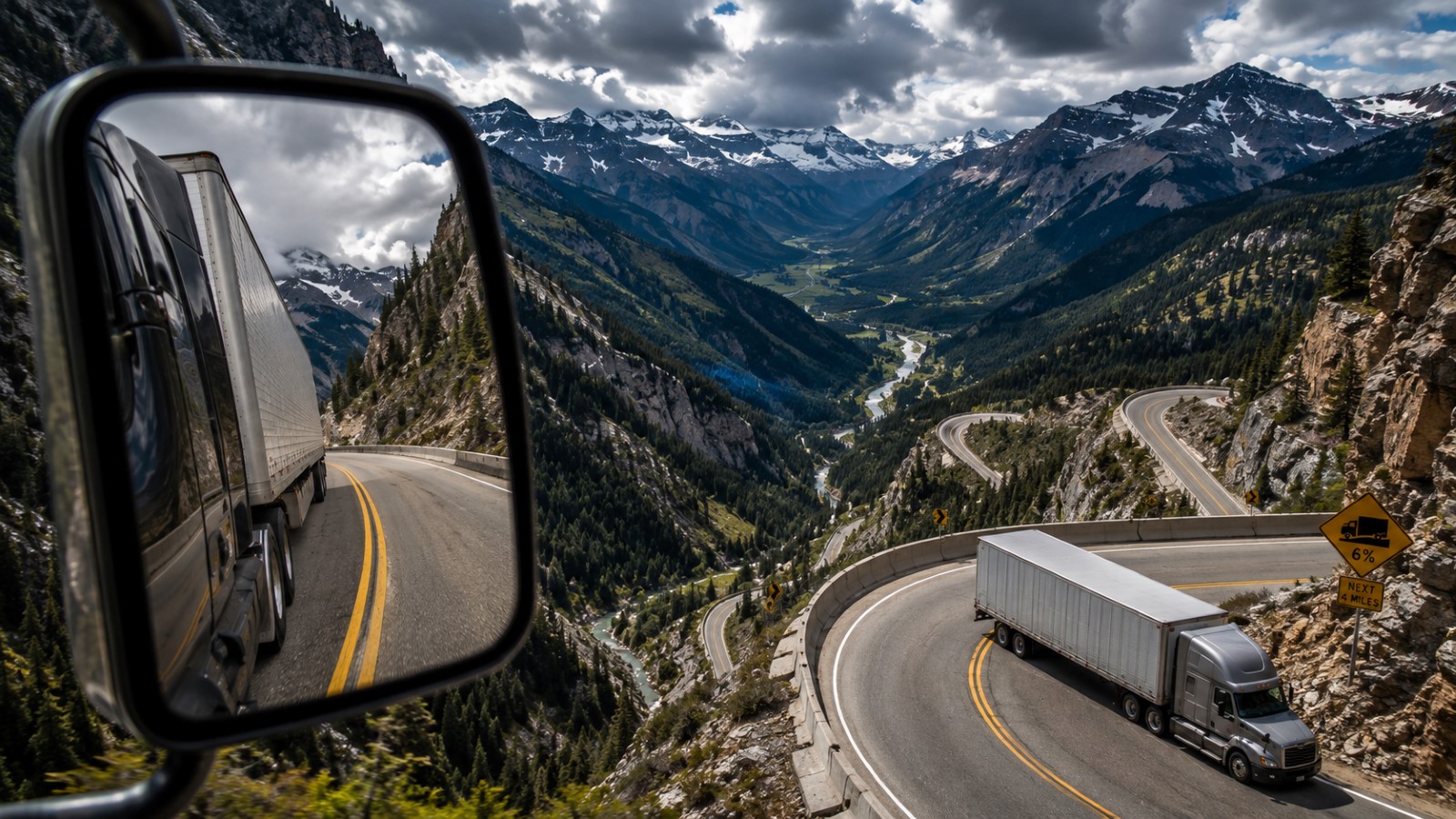
Mountain pass driving can be one of the most demanding parts of a trucker's route. Long grades, sharp curves, changing weather, snow and ice, and heavy loads can all affect how a tractor-trailer accelerates, handles, and stops.
For commercial drivers, downhill control is especially important. The FMCSA Commercial Driver's License Manual* warns that excessive use of service brakes can cause overheating and brake fade, while engine braking should provide the primary braking effect on long or steep downgrades. The safest mountain-driving strategy starts before the truck reaches the pass: inspect the vehicle, understand the upcoming grade, check road and weather conditions, and know what traction or chain requirements apply.
The FMCSA Commercial Driver’s License Manual is an official guide from the Federal Motor Carrier Safety Administration covering CDL licensing, testing, safety requirements, and commercial driving rules.
Key Facts:
- FMCSA's CDL guidance gives a controlled-braking example of reducing speed from 40 mph to 35 mph with a brake application of about 3 seconds.
- Oregon's commercial-driver guidance specifies minimum tire tread depths of 4/32 inch on front tires and 2/32 inch on other tires.
- California requires heavy-duty vehicles over 6,500 pounds to be equipped with chains when posted chain requirements apply.
- Colorado requires qualifying commercial vehicles weighing 16,000 pounds or more to carry chains during the September 1 through May 31 chain season on designated routes.
- Colorado's Must Carry Law covers more than 1,400 centerline miles and includes approximately 130 designated chain stations.
- Colorado has 22 designated chain stations along the I-70 mountain corridor.
What Makes Mountain Pass Driving Different for Truckers?
Mountain roads combine steep grades with curves, elevation changes, limited sight distance, and rapidly changing weather. For large commercial vehicles, these conditions create additional demands on braking, steering, and tire traction. The Federal Highway Administration's guidance on steep grades and pavement friction recognizes the additional challenges that steep grades can create for large commercial vehicles, particularly when braking, curves, and reduced pavement friction are involved.
Before entering a major mountain pass, drivers should consider the grade and length of the route, vehicle weight, brake and tire condition, current weather, chain requirements, available escape ramps, and any truck restrictions. These factors can affect speed control, stopping distance, traction, and overall vehicle stability, especially on long or steep grades.
How Should You Prepare a Semi Truck for Mountain Driving?
A thorough pre-trip inspection becomes especially important before a long climb or descent. The Oregon Commercial Driver Manual recommends checking tire condition and tread depth and emphasizes carrying the correct number of chains and extra cross-links when winter conditions may require them.
Drivers should pay particular attention to:
- Service brakes and brake adjustment
- Air-brake system
- Tires and tread depth
- Wheels and steering components
- Engine cooling system
- Cargo securement
- Fuel level
- Chains or approved traction devices
Oregon's current CDL guidance specifies at least 4/32 inch of tread depth in every major groove on front tires and 2/32 inch on other tires.
Mountain-Pass Preparation Checklist
How Should Truckers Handle a Long Mountain Climb?
Mountain driving is not only about going downhill. Long uphill grades can also put significant demands on the engine, cooling system, and drivetrain.
Before a sustained climb, drivers should select an appropriate gear, monitor engine temperature, and avoid unnecessary speed changes that can make it harder to maintain momentum.
Drivers should also watch traffic building behind the truck and use designated pullouts or slower-vehicle areas when appropriate and safe. The key is to manage the climb before the engine or drivetrain becomes overloaded, rather than waiting for a warning sign or performance problem.
How Do You Drive a Semi Truck Downhill Safely?
The most important principle of downhill truck driving is to control speed before the truck begins accelerating excessively.
The FMCSA CDL Driver's Manual says drivers should select the proper low gear before beginning a downgrade and use the engine's braking effect as the primary braking assistance, with service brakes providing additional control.
A practical downhill sequence is:
1. Evaluate the grade and road conditions.
2. Select the appropriate lower gear before the descent.
3. Establish a safe speed.
4. Use engine braking or another manufacturer-approved auxiliary braking system.
5. Apply the service brakes when additional speed reduction is needed.
6. Maintain adequate following distance.
7. Continue monitoring speed, brakes, and road conditions.
The exact gear and speed depend on the truck, load, grade, weather, and posted restrictions, so drivers should follow their CDL training, carrier procedures, and the manufacturer's instructions.
What Is the Proper Braking Technique for a Steep Downgrade?
FMCSA provides a particularly useful numerical example for controlled braking on a long or steep downgrade. Once the vehicle is in the proper low gear, the manual describes applying the brakes firmly enough to produce a definite slowdown, reducing speed by approximately 5 mph, and then releasing the brakes. If the vehicle returns to the selected safe speed, the process is repeated.
This is an illustrative FMCSA example, not a universal speed prescription. A safe speed must account for the actual grade, load, traffic, weather, road surface, and posted limits. The central lesson is that the service brakes should supplement engine braking rather than carry the entire braking load.
How Does Engine Braking Help on a Mountain Descent?
Engine braking helps resist the truck's acceleration without relying entirely on the service brakes.
Depending on the truck, this may involve:
- Engine braking
- Exhaust braking
- An engine retarder
- Another manufacturer-approved auxiliary braking system
Using an appropriate auxiliary braking system can reduce the amount of heat generated by repeated service-brake applications.
FMCSA explains that excessive service-brake use can cause overheating and brake fade, while brakes that are out of adjustment can increase the workload on the other brakes. However, drivers should follow the vehicle manufacturer's instructions regarding auxiliary braking systems and road conditions. The Oregon Commercial Driver Manual, for example, cautions that retarders can cause drive-wheel skidding when traction is poor and says they should be turned off when roads are wet, icy,y or snow-covered.
How Much Following Distance Should a Truck Maintain Downhill?
Following distance becomes even more important on mountain roads because a heavy commercial vehicle needs adequate room to respond to traffic changes. According to FMCSA's CMV Following Too Closely guidance*, drivers traveling below 40 mph should leave at least 1 second for every 10 feet of vehicle length. At speeds above 40 mph, drivers should add another second.
These are baseline examples, not a substitute for judgment. More space may be necessary when visibility, traction, traffic, or road conditions deteriorate.
FMCSA’s “Following Too Closely” guidance is an official safety resource explaining how commercial drivers should maintain enough following distance to stop safely and react to sudden changes in traffic.
What Should You Do If Truck Brakes Fail Downhill?
A serious loss of braking ability on a mountain descent is an emergency. The priority is to maintain control and use the safest available means of stopping.
If braking performance deteriorates:
- Keep the vehicle under control.
- Use available auxiliary or engine braking as appropriate.
- Avoid abrupt steering movements.
- Look for a designated truck escape or runaway ramp.
- Warn other road users when it can be done safely.
- Follow your company's emergency procedures.
The FMCSA CDL Driver's Manual specifically discusses escape ramps as an option when a vehicle's brakes fail on a downgrade. The FHWA Manual on Uniform Traffic Control Devices (MUTCD) states that, where applicable, truck escape-ramp warning signs should generally be placed approximately 1 mile and ½ mile in advance of the grade and escape ramp, with another sign at the gore.
Are Tire Chains Required for Semi-Trucks on Mountain Passes?
They can be, but there is no single nationwide chain requirement for every semi truck. Requirements depend on the state, highway, vehicle configuration, and weather or traction controls.
What Are California's Truck Chain Requirements?
California does not use a fixed calendar date for when commercial vehicles must carry tire chains. Instead, chain requirements are based on weather and road conditions and can be activated when snow, ice, or other winter hazards make additional traction necessary. According to the official Caltrans Truck Chain Requirements page, drivers must follow posted chain-control signs and be prepared to install chains when required.
California uses three primary levels of chain control, such as:
- R-1 is the least restrictive level and requires chains on most vehicles, although certain vehicles equipped with qualifying snow tires may be exempt. These exemptions do not necessarily eliminate the requirement to carry chains.
- R-2 is more restrictive and requires chains on most vehicles, while certain qualifying four-wheel-drive vehicles equipped with snow tires on all four wheels may be allowed to proceed without installing chains. Even vehicles using this exemption must carry chains for one set of drive wheels.
- R-3 is the most restrictive level, requiring chains on all vehicles without exception. Because conditions are typically severe at this level, Caltrans notes that a highway will often be closed before R-3 restrictions are imposed.
For truck drivers, the most important point is that snow tires do not automatically replace chain requirements when controls are posted. Commercial vehicles traveling through California's mountain passes should carry the correct chains and keep them readily accessible rather than buried under cargo or equipment. Drivers should also watch for advance warning signs and chain-control checkpoints, where they may be directed to stop and install chains before continuing.
Chain requirements can change quickly as conditions deteriorate or improve, and restrictions may differ between sections of the same highway. When chains are required, Caltrans generally limits vehicle speeds to 25 or 30 mph, depending on the posted conditions. Truck drivers should reduce speed, increase following distance, avoid sudden braking or steering, and use extra caution on curves, steep grades, and icy sections.
What Are Oregon's Truck Chain Requirements?
Oregon's chain law applies statewide. The Oregon Department of Transportation's commercial-vehicle winter guidance states that all commercial vehicles over 10,000 pounds GVW must carry chains whenever road conditions might require their use or Snow Zone signs are posted. ODOT provides specific chain-placement requirements based on vehicle configuration. Its Chains and Traction Tires guidance explains where chains must be installed on different commercial vehicle and trailer configurations.
Oregon can also impose conditional road closures during severe conditions. In those situations, chain requirements can become more restrictive, making current road signs and ODOT travel information particularly important before crossing a mountain pass.
What Are Colorado's Truck Chain Requirements?
Colorado's rules are especially important for commercial drivers because the state's Must Carry Law applies to qualifying vehicles on designated routes.
According to the Colorado Department of Transportation's Must Carry Law information, the law requires commercial motor vehicle drivers to carry chains from September 1 through May 31. The law applies to vehicles with a combined weight of more than 16,000 pounds used in commerce or to transport at least 16 passengers, including the driver, on public highways. CDOT reports that more than 1,400 centerline miles are subject to the law and that there are approximately 130 designated chain stations, including 22 along the I-70 mountain corridor.
Because Colorado's requirements apply to designated roads, drivers should confirm whether their specific route falls under the law rather than assuming every Colorado highway has identical requirements. For current road conditions and chain-law alerts, CDOT directs drivers to its COtrip road-information system.
What Are the Biggest Risks of Truck Driving on Mountain Roads?
The biggest risks generally involve speed, braking, traction, and road geometry.
Weather can magnify several of these risks at once, which is why mountain driving requires continuous adjustment rather than a single fixed driving strategy.
What Should Truckers Remember Before Entering a Mountain Pass?
Mountain pass driving is ultimately about managing speed, momentum, braking, and traction before they become emergencies.
Before starting a major descent, make sure you know:
- What grade is ahead
- How long the downgrade lasts
- What speed restrictions apply
- Which gear is appropriate
- Where brake-check areas are located
- Where runaway ramps are located
- What weather and road conditions are expected
- Whether chains or traction devices are required
- How much following distance you need
The numbers are useful, but they should never replace judgment. A 40-mph FMCSA braking example is not permission to descend every mountain grade at 40 mph, and having the required chains does not mean conditions are safe. The best mountain-driving strategy is to prepare early, control speed before the descent becomes difficult, use the truck's braking systems appropriately, maintain sufficient following distance, and leave yourself enough room to respond when conditions change.
Frequently Asked Questions
What gear should a semi truck use going downhill?
The appropriate gear depends on the truck, load, grade, road conditions, and manufacturer guidance, but FMCSA recommends selecting the proper low gear before starting a long or steep downgrade.
How do truckers brake on steep mountain roads?
Truckers should use engine braking as the primary braking effect on long or steep downgrades and use the service brakes as a supplement to control speed.
How do you prevent truck brake fade on a mountain pass?
The best prevention is to control speed before the descent, select the proper gear, use available engine or auxiliary braking appropriately, and avoid continuous service-brake application.
When are chains required for semi trucks?
Chain requirements vary by state and road conditions, so drivers should check current state DOT requirements and posted signs before entering a mountain corridor.
What is a runaway truck ramp?
A runaway or escape ramp is a specially designed roadside facility intended to stop heavy vehicles that can no longer safely control their speed on a steep downgrade.
How much following distance should a semi truck maintain?
FMCSA recommends at least one second for every 10 feet of vehicle length below 40 mph, with an additional second when traveling above 40 mph.


