



Best Way to Check Tire Pressure on a Semi-Truck

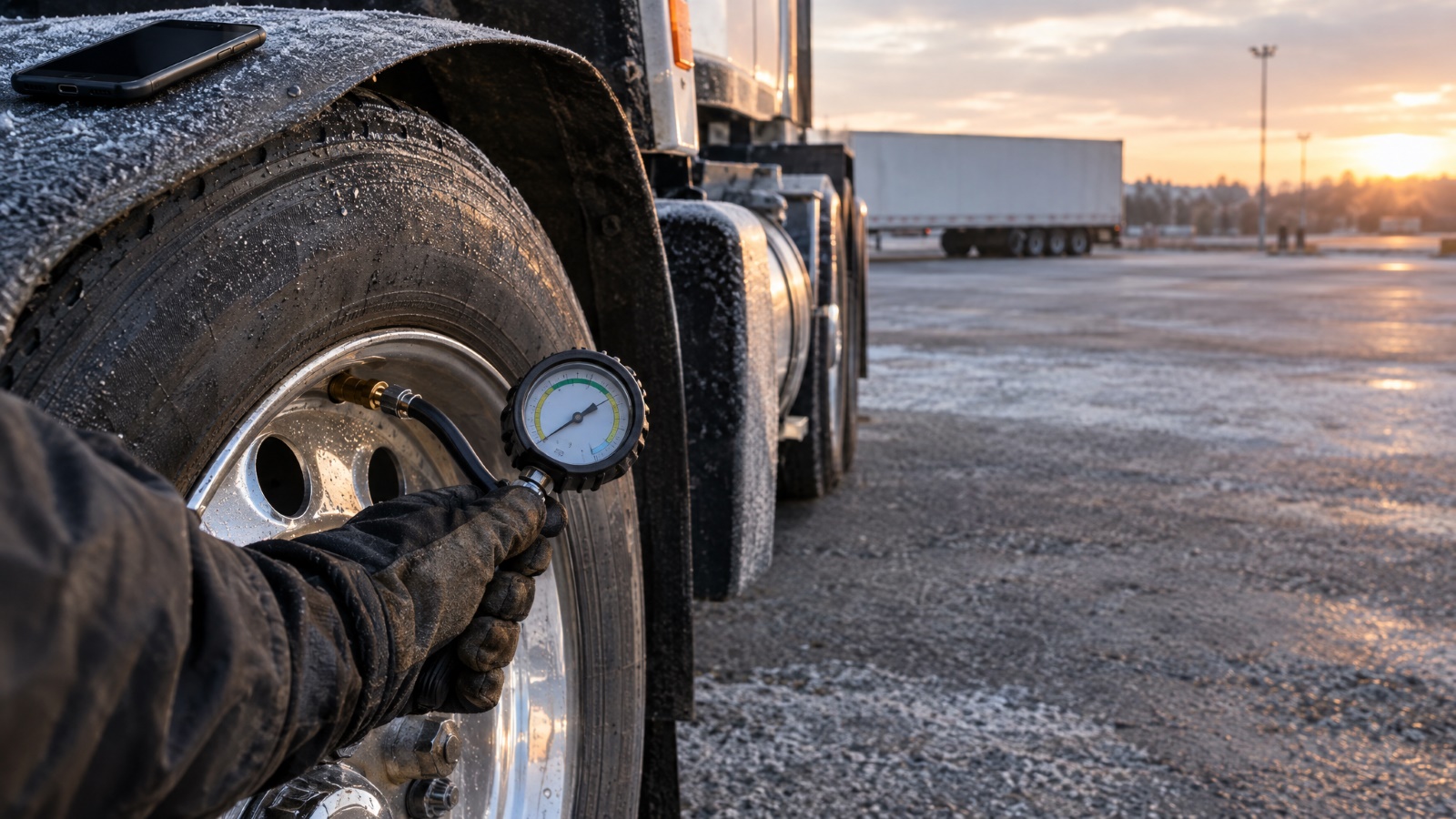
The best way to check tire pressure on a semi-truck is to use a calibrated gauge on every tire, including the inside duals and the spare, while the tires are cold, and compare each reading with the pressure your tire maker lists for your load. Looking at a tire or hitting it with a tire billy cannot tell you its pressure.
A typical five-axle semi-truck rolls on 18 tires, and each one can lose air without any sign. The U.S. Tire Manufacturers Association (USTMA) says truck tires may lose 2 to 4 psi per month under normal conditions. Under-inflation builds heat and internal damage that can lead to tread or belt separation, even at a later date.
A regular check is how you catch it first, and the check is only as good as the tools behind it.
Key Facts:
- Check cold, with a calibrated gauge. Measure every tire, including the inside duals and the spare, after the truck has sat three hours or been driven under one mile.
- Use the target for your load. The right pressure comes from the tire maker's load and inflation table, not the sidewall maximum.
- Hot tires read higher. Pressure rises about 2 psi per 10°F, and the gap can reach 20 psi, so never let air out of a hot tire.
- 80% of target or less means flat. Take the tire off the vehicle and have it inspected instead of adding air.
- Tires lose air steadily. Expect 2 to 4 psi per month, plus 2 to 4 psi for every 10°F of temperature drop.
- The law covers inflation. Under 49 CFR 393.75, a truck must not run on a tire with a cold pressure below the specified level for its load.
What Do You Need To Check Tire Pressure?
Start with the gauge, because every later step depends on it. A wrong number looks just like a right one.
With the tools ready, the next decision is when to measure, because the same tire reads differently depending on its temperature.
When Should You Check Tire Pressure, Hot Or Cold?
Check cold. A tire is cold when the truck has been parked for at least three hours, or driven less than one mile at moderate speed. After a few hours on the highway, truck tires take about three hours to cool to the outside temperature.
The reason is heat. Tire pressure rises with temperature by about 2 psi for every 10°F, and the gap between hot and cold pressure can reach 20 psi. Federal rules build in the same idea.
Under 49 CFR 393.75*, a truck must not run on a tire with a cold inflation pressure below the pressure specified for its load, and an inspector estimates cold pressure from a hot reading by subtracting 15 psi (for tires rated over 4,000 lbs, after an hour averaging 41 to 55 mph).
That is why a high reading after a long run is normal, and why you should never let air out of a hot tire. Once you know when to measure, you need to know what number to measure against.
49 CFR 393.75 is the FMCSA regulation on tires for commercial motor vehicles. It sets the conditions under which a truck may not be operated on a tire.
What Pressure Should Each Tire Have?
There is no single number. The right pressure depends on the tire, the load it carries, its configuration, and the application. Use the pressure your fleet or vehicle manufacturer specifies on the vehicle placard or in the service manual, and check it against the tire maker's load and inflation table for your tire model and your actual load.
The pressure molded on the sidewall belongs to the tire's maximum load. Do not exceed it without first contacting the tire and rim or wheel manufacturer. Because the target follows the load, it changes when the load does, so look it up again after loading or unloading.
With a calibrated gauge, cold tires, and a target for today's load, you can start the walk-around.
How Do You Check Tire Pressure On A Semi-Truck? The Walk-Around Method
Pick one route and use it every time, so a tire never gets skipped. Start at the front left tire and go clockwise around the tractor, then do the trailer, and finish with the spare. At every tire, do four things in the same order.
1. Look. Check the sidewall for cuts and bulges, and check between the duals for stones or rubbing.
2. Check the valve. Make sure the cap is on, and the stem is straight and undamaged. If you suspect a leak, spray soapy water on the valve core and stem. Bubbles mean air is escaping.
3. Gauge it. Press the gauge straight onto the valve with a firm, quick motion. If air hisses, reseat it. Compare the number with the target for your load.
4. Record it. Log the date, tire position, tire ID number, whether the tire was cold or hot, and the pressure.
If a tire is low, add air, read it again, and replace every valve cap before you move on. Taking the readings is only half the job. The next step is deciding what each number means.
What Does Each Reading Mean? The Reading-to-Action Card
Compare each reading with its target first, then with its neighbors on the same axle. Both steers should read about the same, and so should the drives and the trailer tires.
The 80 percent rule exists because a tire that low may be damaged inside and can rupture with explosive force while it is being inflated. The card is easier to trust once you see it applied, so here are four examples.
Worked Examples
These use a 100 psi cold target for illustration. Use your own target from the load table.
- Morning, tires cold. A steer tire reads 96 psi. It sits at 96 percent of target, so it is low but not flat. Add 4 psi, read it again, check the valve and cap, and log it. If it needs air again within a few days, look for a slow leak.
- Truck stop after four hours on the highway. Three drive tires read 108, 110, and 112 psi. All are above target and within 5 psi of each other, which matches normal heat buildup. Do not bleed them. Recheck cold at the next opportunity.
- Same truck stop. A trailer tire reads 99 psi while its neighbors read 108. A hot tire at or below the cold target is a warning sign, and it sits well below its mates. Find the cause before you drive on.
- Morning, tires cold. A tire reads 78 psi. That is 78 percent of the target. Treat it as flat. Do not inflate it on the truck. Remove it and have it inspected.
Examples like these are only as good as your access to every valve, and the inside dual is where that usually breaks down.
How Do You Check The Inside Dual?
Check it directly. Never assume the inside tire matches the outside one, because the two are independent and an inside dual can lose pressure with no outward sign. Inside duals also run in more severe conditions, so skipping them is a costly habit.
Reaching the valve is the real obstacle. A long hose or angled gauge is the simplest answer. Valve stem extensions can help, but only use them if they are secure and leak-free, because an extension can add a leak path of its own.
When a tire is mounted, you can also ask the shop to position the stems so both are reachable. Trucks with TPMS or a central inflation system give you another way to read the inside tire.
The same sensors raise a question: if the truck reports pressure on its own, is the gauge still needed?
Can TPMS Replace A Gauge?
No. Keep checking with a calibrated gauge even on trucks with a tire pressure monitoring system (TPMS), because some systems warn late or miss a flat. Use TPMS for monitoring between checks, and the gauge to verify a tire and to confirm the sensors.
Whether or not you run TPMS, a short list of habits causes most wrong readings.
What Mistakes Give A Wrong Reading Or A Wrong Fix?
Avoiding these mistakes only works if you check often enough, so the schedule comes next.
How Often Should You Check Tire Pressure?
Check all tires, including the spare and the inside duals, often: daily during continuous service, at every pre-trip inspection, and at preventive maintenance intervals. That applies to trucks with TPMS too.
Temperature changes the schedule. A truck tire can lose 2 to 4 psi for every 10°F of temperature drop, and regular operation at a very different altitude or temperature calls for a check and adjustment. A cold snap is a reason to check before your next trip. Below freezing, moisture in the inflation air can freeze in the valve core and cause a leak or flat, so take care when adding air.
A tire that keeps losing air is a different problem. If it loses more than 4 psi per month continuously, have a professional check it.
A written record turns a routine check into early warning. A few weeks of entries show which tire keeps losing air, which dual pair never matches, and how your tires react to a cold snap. Copy this into a notebook or phone note and fill in one row per tire.
What Should You Do When A Tire Is Low?
Start with the reading-to-action card to decide whether to top the tire up or take it out of service. Look for the cause, such as a nail, a damaged valve, or a bad cap, and fix it before you continue.
Some conditions end the trip. Under 49 CFR 393.75, a truck must not be operated on a flat tire, with an audible leak, or with body ply or belt material exposed through the tread or sidewall.
That decision is easy near your own shop and much harder on a highway far from home, which is where roadside help comes in.
How Do You Get Help With a Tire When You're Far From Your Shop?
Request tire service through Trucker Guide Roadside Assistance, compare offers from nearby providers, and choose the one that fits your price and arrival time. Stuck drivers tend to take the first quote they hear, and comparing offers avoids that.
Here is how the request works in the app:
1. Tap "Roadside Assistance" at the top of the app, then sign up or log in.
2. Select your vehicle (truck, trailer, bus, or RV) and choose tire service.
3. Choose the affected tire position, for example, the right-side steer tire or a drive tire.
4. Add the tire brand and size. If your size is not listed, choose "Other" and enter it in the comments.
5. Add vehicle details and a photo if you can, so the provider knows what to bring.
6. Set your location and search radius. Start small if you need help fast. Widen it if few providers show up.
7. Submit the request and review offers. Each offer shows the provider, price, and estimated arrival time. Open an offer to see ratings, reviews, and notes.
8. Claim the offer you want and track the provider's arrival time on the timer in the app.
Better still, know your options before a tire fails. Browse truck tire repair locations on Trucker Guide and note a few along your route. You do not need a Trucker Guide navigation subscription to use Roadside Assistance. You pay the provider's price plus a $19.99 Trucker Guide service fee. Request roadside assistance.
Good tire habits are cheap: a few minutes, a calibrated gauge, and a log. Add to that a plan for the day a tire fails far from home. Download Trucker Guide to find truck tire repair locations along your route, and use Roadside Assistance when you need help on the spot.
Frequently Asked Questions
What is the best way to check tire pressure on a semi-truck?
Use a calibrated gauge on every tire, including the inner duals, while the tires are cold, and compare each reading with the pressure recommended for your load.
Should I check semi-truck tire pressure hot or cold?
Cold. Driving raises the pressure, so a hot reading is higher than the real cold pressure. Never release air from a hot tire.
How do I check the inner dual tires?
Use a gauge with a long hose, valve stem extensions, or tire pressure monitoring sensors.
Can TPMS replace a tire gauge?
No. TPMS is useful for continuous monitoring, but use a calibrated gauge to verify any tire that looks wrong.
Is the tire thumper reliable?
No. It can show a completely flat tire, but not one that is only somewhat low. Use a gauge.
How often should I check tire pressure on a semi-truck?
At every pre-trip inspection, and at long stops once the tires have cooled. Check more often in cold weather.
What is the legal rule for tire inflation?
A truck must not be operated on a tire with a cold inflation pressure lower than the pressure specified for the load it carries (49 CFR 393.75).


