


1
Get to a Safe Place and Contact the Company
Move the truck out of traffic if possible, use the required warning equipment, and call dispatch or the company's breakdown service. Do not continue driving if the truck may be unsafe.



Recently, the Trucker Guide team came across a discussion in the r/Truckers community that caught our attention. One driver described how his truck broke down and had to be taken to a dealership. The repair costs came as a surprise, and the situation became even more frustrating when the driver was left waiting for answers about the repairs and what the company planned to do next.
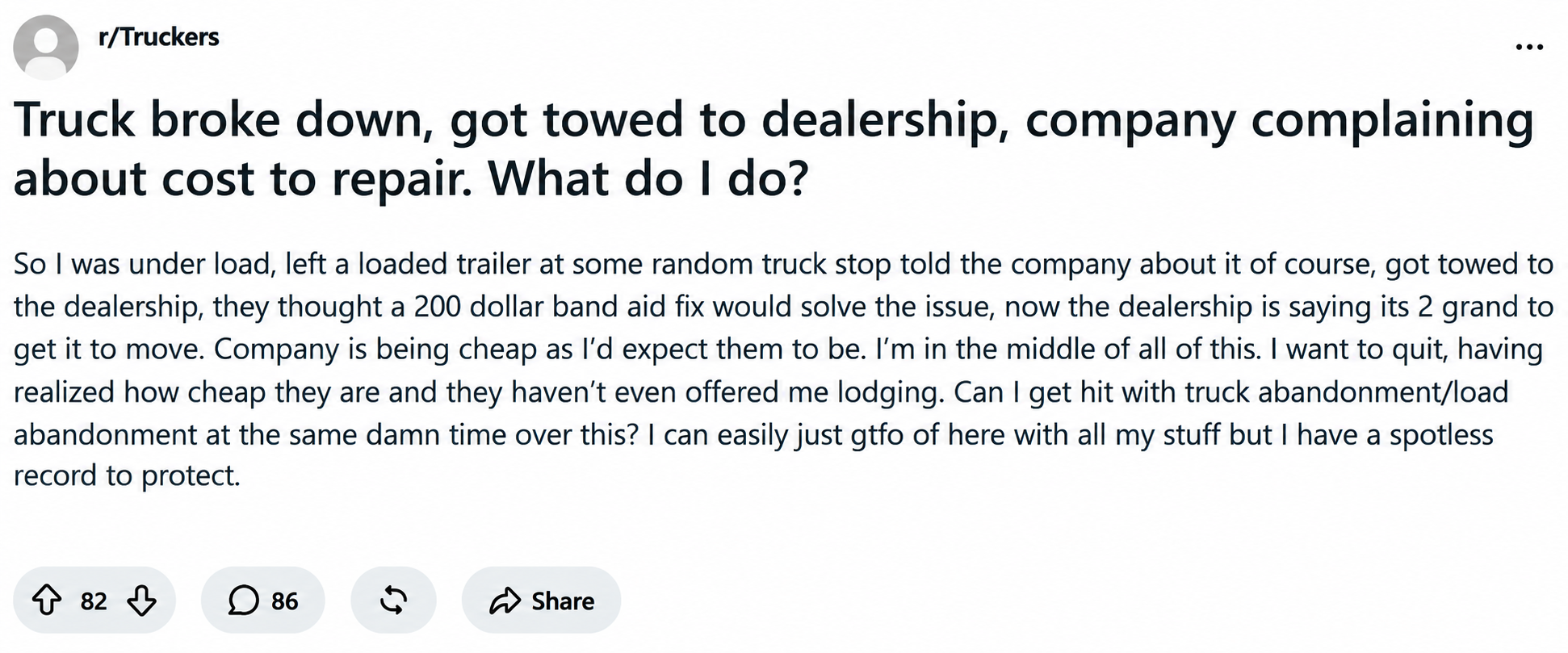
So what should a trucking company do when one of its trucks breaks down? What can a driver do if the situation isn't being handled properly?
When a company truck develops a mechanical problem, the carrier is responsible for keeping its vehicles in safe operating condition. Federal regulations require motor carriers to systematically inspect, repair, and maintain the trucks they operate.
Under 49 CFR § 396.3, carriers must make sure their vehicles and equipment are properly maintained. They must also keep records of inspections, repairs, and maintenance.
Drivers have responsibilities as well. They must report defects that could affect the safe operation of the truck. Under 49 CFR § 396.11, carriers must review these reports and make sure any defects that need repair are addressed before the vehicle is operated again.
The company should coordinate repairs and determine when the truck is safe to return to service. Drivers must report mechanical problems promptly and should never be pressured to operate a truck with a serious safety issue.
Getting a broken-down truck to a repair shop is only the first step. The company also needs to deal with everything that happens while the truck is out of service. This can become a serious problem when repairs take several days. The driver may not know whether to stay at the dealership, where to leave the trailer, or how the delay will affect their pay. These are the kinds of questions that should not be left unanswered.
Here’s how responsibilities can be divided.
The company may not be able to control how quickly a repair shop finishes the job. Parts may be unavailable, the dealership may have a long waiting list, or the mechanic may discover another problem during the inspection. But the driver should still receive updates and know what happens next.
Hotel costs are another issue to consider. FMCSA regulations do not establish a general requirement for a trucking company to provide a hotel after every breakdown. Whether the company covers a hotel usually depends on its policy, the employment agreement, and the circumstances.
Drivers should ask about this in advance rather than wait until they’re stranded near a repair shop.
When a truck is out of service for several days, the driver may lose more than time. If they are paid by the mile, a long repair can mean a much smaller paycheck that week.
This is one of the issues raised by the driver in the Reddit discussion. Waiting for a repair is frustrating on its own, but not knowing how that time will affect your pay makes the situation even harder. Whether waiting time must be paid depends on the circumstances. The U.S. Department of Labor distinguishes between time when an employee is still required to remain available for work and time when they have been completely relieved of their duties.
If a driver is required to remain on duty and cannot use the waiting time effectively for personal activities, that time may count as hours worked. If the company fully relieves the driver of their duties and they are free to use the time for themselves, the waiting period may be treated differently.
Some commercial truck drivers qualify for the federal Motor Carrier Exemption, which removes the FLSA* requirements for overtime pay. Eligibility depends on the driver’s duties and the type of transportation involved. The exemption does not automatically settle questions about minimum wage or whether waiting time counts as hours worked.
If your truck is stuck at a dealership and you are not sure how the waiting period will be paid, ask your dispatcher or payroll department. Check your employment agreement and keep a record of when you were told to remain available and when you were released from duty. If something does not look right, the U.S. Department of Labor can provide information about your rights.
The Fair Labor Standards Act (FLSA) is a U.S. federal law that establishes minimum wage, overtime pay, and rules for determining which waiting periods count as hours worked. For truck drivers waiting for repairs, this means the time may be paid if they must remain on duty or available to work, but the rules depend on the circumstances and applicable exemptions.
When a truck breaks down, there is usually a lot to deal with at once. The driver needs to contact the company, arrange help, find out what is wrong, and figure out what happens to the load.
Here are a few steps that can help.
A few phone calls and written confirmations may save a lot of trouble later. If there is a disagreement about repair costs, waiting time, or instructions from dispatch, having a record of what happened can make a difference.
No company can guarantee that a truck will never break down. Even vehicles that receive regular maintenance can develop unexpected problems.
But drivers should not be left to handle everything on their own once something goes wrong.
Think about the situation described in the Reddit post. The truck was already at the dealership, but the driver was still trying to find out what would happen next. A repair delay may be outside the company's control. Keeping the driver informed is not. A reliable company should have someone drivers can contact when they break down. It should explain who is arranging the repair, provide updates when there is new information, and give clear instructions about the load and the driver's next steps.
Drivers should also be able to get straightforward answers about breakdown pay, hotel arrangements, and approved expenses. If they have to wait for repairs, they may need a safe place to park or access to basic facilities. Trucker Guide can help them find truck parking locations and truck stops with showers.
Most drivers ask about pay, home time, benefits, and equipment before joining a trucking company. It is also worth asking what happens when a truck breaks down.
The driver who shared his experience on Reddit was dealing with several problems at once, including a repair that took longer than expected, unexpected costs, and uncertainty about the company’s response. Knowing the company’s breakdown policy beforehand could help prevent some of that confusion.
Before accepting a job, ask the recruiter or company representative a few questions.
The answers can tell you a lot about how the company handles problems that drivers cannot control.
The discussion that caught our attention started with one driver whose truck broke down and ended up at a dealership. But what made the situation frustrating was not just the mechanical failure. It was having to wait for repairs while also trying to find out what the company was going to do. Every driver hopes to avoid a breakdown, but if one happens, they should at least know who to call, what support to expect, and what comes next.
Good luck and safe travels!
The trucking company generally handles repairs to its company trucks. Federal regulations require carriers to inspect, repair, and maintain the vehicles they operate. Drivers should report the problem and follow the company's repair instructions.
No. Federal regulations do not generally require trucking companies to provide hotel accommodation after every breakdown. Coverage depends on company policy, the employment agreement, and the circumstances.
Sometimes. Under the FLSA, waiting time may count as hours worked if the driver must remain on duty or available to work. If the driver is completely relieved of duties and free to use the time for personal activities, the waiting period may not be paid.
Not without clear instructions from the company. The driver should confirm who is responsible for the cargo and arrange a proper handover before leaving the trailer.
No, if the defect makes the truck unsafe to operate. Safety-related defects must be repaired or determined not to require repair before the vehicle returns to service.


