


 Blog
Operation Highway Shield: More Than 300 Truckers and Vehicles Pulled Off U.S. Roads

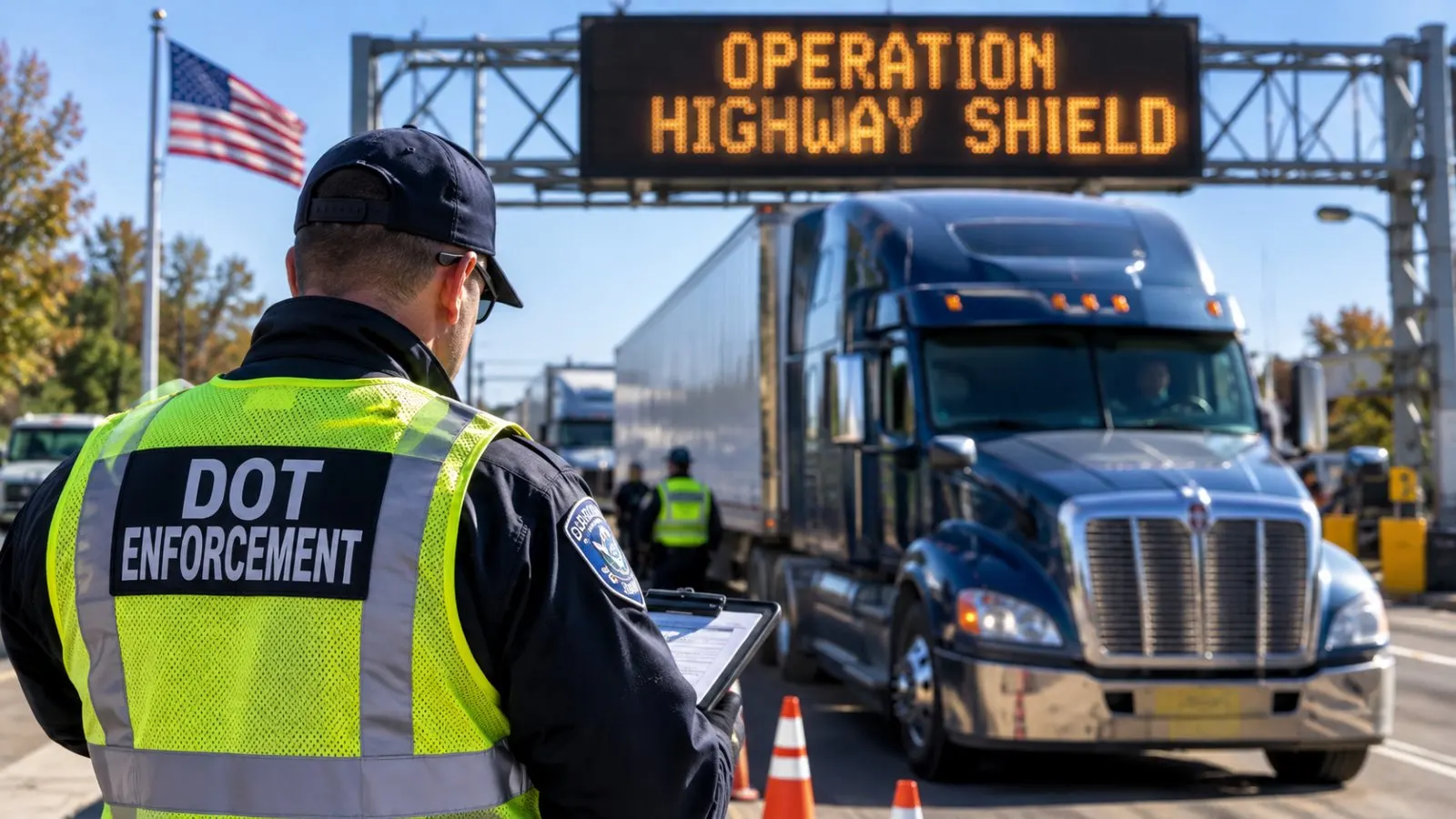
Operation Highway Shield is a nationwide commercial vehicle enforcement initiative aimed at identifying unsafe drivers, removing unqualified operators from the road, and addressing violations involving English language proficiency, driver credentials, and immigration status.
The latest enforcement wave took place in Arkansas from October 27 to 29, 2026. During the 48-hour operation, authorities conducted 1,724 inspections and placed 393 drivers and commercial motor vehicles out of service.
The results highlight the scale of the initiative and the growing scrutiny facing trucking companies and commercial drivers across the United States.
Key Facts:
- Operation Highway Shield's latest enforcement wave took place in Arkansas from October 27 to 29, 2026.
- Authorities conducted 1,724 commercial vehicle inspections during the 48-hour operation.
- A total of 393 drivers and commercial motor vehicles were placed out of service.
- Inspectors recorded 183 English language proficiency violations.
- Authorities referred 74 immigration-related cases for federal enforcement.
- The operation resulted in 44 criminal arrests and the recovery of one stolen trailer.
- Arkansas authorities also reported more than 1,000 motor carrier safety violations and over 330 unqualified or unauthorized drivers.
What Happened in Arkansas During the Latest Operation?
The latest wave in Arkansas produced several significant enforcement results. According to the U.S. Department of Transportation, authorities conducted 1,724 inspections over 48 hours.
Additional figures reported by Arkansas authorities included more than 1,000 motor carrier safety violations, over 330 unqualified or unauthorized drivers identified, and 369 citations and warnings.
These numbers cover different enforcement categories and should not be interpreted as a count of unique drivers. In particular, the 393 out-of-service orders included both drivers and vehicles, while immigration referrals and language violations were reported separately.
Why Is English Language Proficiency a Major Enforcement Priority?
English language proficiency is one of the main areas targeted by Operation Highway Shield.
Under 49 CFR § 391.11(b)(2), commercial motor vehicle drivers must be able to read and speak English well enough to communicate with the public, understand highway traffic signs and signals, respond to official inquiries, and complete required reports and records. Authorities recorded 183 English language proficiency violations during the Arkansas operation. A driver who fails to meet this requirement can be placed out of service and prevented from continuing the trip until the issue is addressed.
The requirement applies to commercial drivers regardless of nationality or place of birth. An English language proficiency violation does not, by itself, indicate a driver's immigration status or establish that the driver has violated immigration law.
How Does the Operation Address Immigration and CDL Violations?
Authorities also check immigration compliance and the validity of commercial driver credentials.
During the Arkansas operation, 74 immigration-related cases were referred for federal enforcement. A referral means that authorities identified a matter for further review; it does not necessarily mean the person was arrested, charged, or convicted.
The enforcement effort is taking place alongside changes to the rules governing non-domiciled commercial driver's licenses.
A federal rule that took effect on March 16, 2026, narrowed eligibility for non-domiciled commercial learner's permits and CDLs. Under the updated requirements, eligibility for certain foreign-domiciled applicants is generally limited to individuals with qualifying H-2A, H-2B, or E-2 nonimmigrant status.
These restrictions apply to a specific category of CDL applicants. They do not apply to every foreign-born commercial driver.
Where Has Operation Highway Shield Taken Place?
Operation Highway Shield has included several enforcement waves in different parts of the United States. Reported results include:
The results show the range of issues covered by the initiative, including vehicle safety, driver qualifications, immigration compliance, and criminal investigations. The figures also reflect different reporting categories, so comparisons between operations should take those distinctions into account.
What Does Operation Highway Shield Mean for Trucking Companies and Drivers?
For trucking companies, the expanded enforcement effort reinforces the importance of maintaining accurate driver qualification files, verifying CDL validity, and ensuring that drivers meet federal safety requirements.
Carriers should pay particular attention to:
- Driver qualifications. Confirm that drivers hold the appropriate licenses and endorsements and meet applicable federal requirements.
- English language proficiency. Ensure drivers can communicate effectively with law enforcement, understand road signs, and respond to official inquiries.
- Vehicle compliance. Keep commercial vehicles properly maintained and address inspection-related violations promptly.
- Documentation. Maintain complete and up-to-date driver and vehicle records.
- Regulatory updates. Monitor changes to CDL eligibility, licensing requirements, and roadside enforcement procedures.
For drivers, the message is equally clear: license validity, roadworthiness, and compliance with federal requirements can directly affect whether a trip continues or ends at a roadside inspection.
Can Stricter Trucking Enforcement Improve Road Safety?
Commercial vehicle enforcement can address several factors that contribute to crash risk. Inspections help identify unqualified drivers and unsafe vehicles, while enforcement actions hold carriers accountable for safety violations.
FMCSA crash data shows that the number of fatal and non-fatal crashes declined from 185,018 in 2022 to 164,537 in 2025, a decrease of 11.1%. Fatalities fell from 6,189 to 4,551, while reported injuries decreased from 89,880 to 85,960. The table below provides a year-by-year breakdown of vehicles involved in crashes, crashes, fatalities, and injuries, including the available 2026 figures.
Operation Highway Shield focuses on potential safety risks, including driver qualifications, English language proficiency, and vehicle condition. Inspections can identify violations that lead to drivers or vehicles being placed out of service. However, enforcement activity alone does not show whether an operation has reduced crashes. That requires comparing safety outcomes over time.
Its long-term impact will depend on consistent inspections, proper driver training, vehicle maintenance, and sustained compliance across the trucking industry. Future crash statistics and safety data will help show whether these efforts are making a measurable difference.
Good luck and stay safe out there!
Frequently Asked Questions
What is Operation Highway Shield?
Operation Highway Shield is a nationwide commercial vehicle enforcement initiative focused on identifying unsafe drivers, unqualified operators, invalid credentials, and violations involving English language proficiency and immigration compliance.
Where did the latest Operation Highway Shield take place?
The latest reported enforcement wave took place in Arkansas from October 27 to 29, 2026. Authorities conducted inspections across the state over a 48-hour period.
How many truckers and vehicles were placed out of service in Arkansas?
Authorities reported 393 combined out-of-service orders for commercial drivers and motor vehicles during the Arkansas operation. This figure includes both drivers and vehicles and does not represent 393 individual truck drivers.
How many English language proficiency violations were reported?
Authorities recorded 183 English language proficiency violations during the Arkansas enforcement operation. Drivers must be able to read and speak English well enough to communicate with the public, understand traffic signs, and respond to official inquiries.
Can a truck driver be placed out of service for failing an English language test?
Yes. Commercial drivers who fail to meet federal English language proficiency requirements can be placed out of service and prevented from continuing their trips until they meet the applicable requirements.
Which states were included in previous Operation Highway Shield enforcement waves?
Reported enforcement waves took place in Florida in March 2026 and across Illinois, Indiana, Iowa, and Ohio from July 28 to 30, 2026. Arkansas hosted the latest reported wave from October 27 to 29, 2026.


