



Diesel Engine Rebuild vs. Replacement: Costs, Signs, Options, and What to Replace

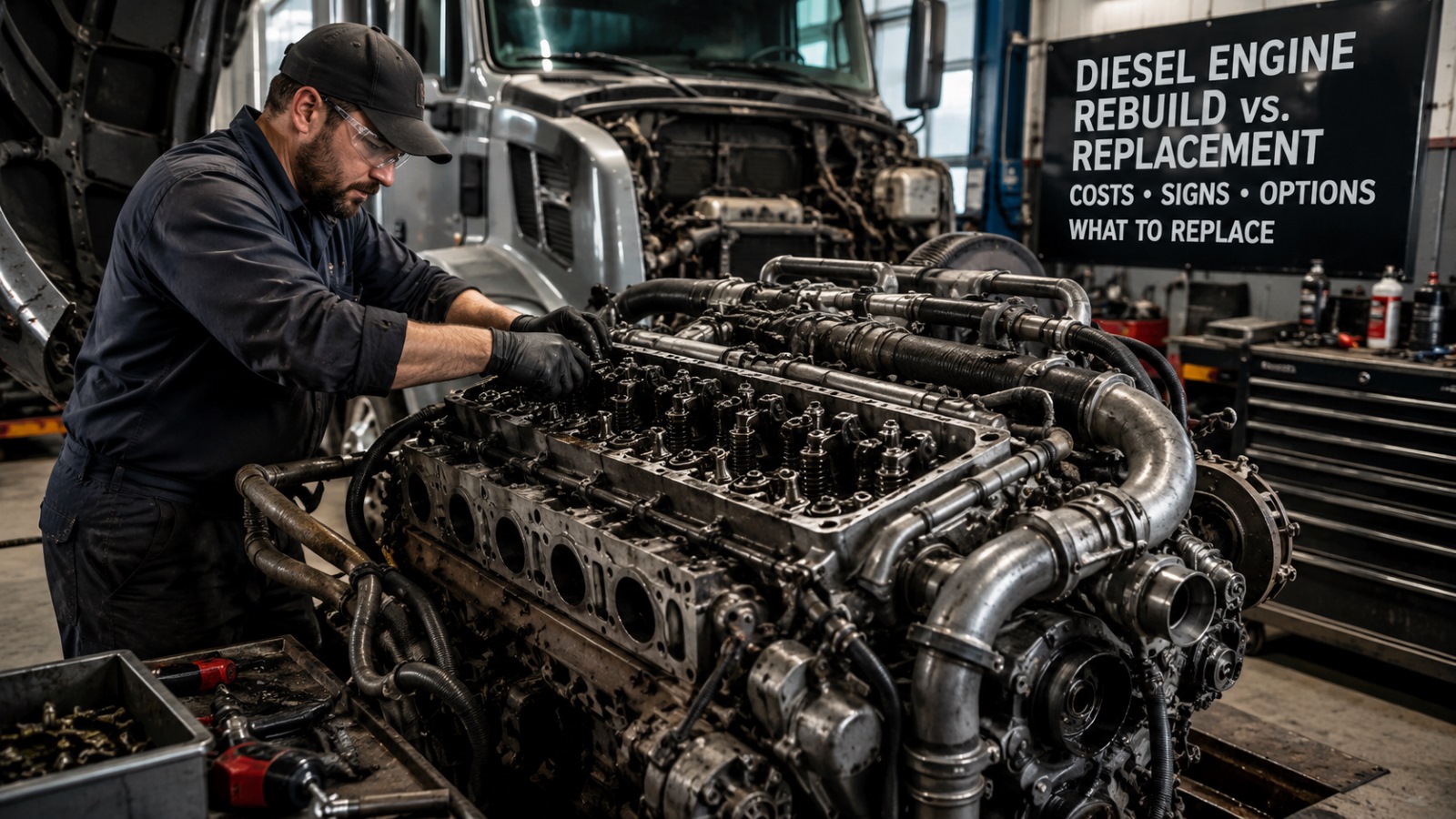
A diesel engine does not automatically need a rebuild or replacement because of high mileage, a check engine light, or a DEF fault. The decision should be based on diagnostic results, the engine's condition, repair costs, downtime, warranty coverage, and the condition of the rest of the truck.
The choices can include repairing one component, performing an in-frame or complete overhaul, installing a remanufactured engine, buying a used engine, or replacing the engine with a new unit.
The right option depends on the engine's condition, the truck's remaining service life, the availability of parts, and the cost of downtime.
Key Facts:
- Cummins recommends giving engines with more than 750,000 miles greater attention when considering an overhaul, while noting that mileage alone does not determine when an engine needs one.
- Current market examples show that a Caterpillar C15 Reman long block can cost about $15,000, while a fully dressed Reman engine can cost about $24,500, before installation and applicable core charges.
- Current listings for used Detroit DD15 engines show prices of approximately $8,500–$17,000, depending on the engine's configuration and condition.
- On July 14, 2026, the EPA published a proposed rule covering model year 2027 and later heavy-duty highway engines and vehicles, including proposed changes to SCR/DEF inducement requirements.
- Before choosing a rebuild or replacement, truck owners should compare at least 5 factors: total installed cost, expected service life, warranty, downtime, and the condition of the rest of the truck.
Is It Better to Rebuild or Replace a Diesel Engine?
There is no single best option for every truck.
A rebuild can make sense when the original engine has a repairable core, and the rest of the truck is in good condition. A remanufactured engine may provide a more predictable repair when internal damage is extensive, or downtime is important.
A used engine usually has the lowest initial purchase price but also carries more uncertainty. A new engine generally provides the greatest predictability but requires the largest investment.
Before making the decision, compare the total installed cost, expected service life, warranty, downtime, and overall condition of the truck, rather than comparing engine purchase prices alone.
Start With Diagnosis Before Replacing the Engine
A check engine light or engine management warning does not prove that the engine needs to be rebuilt.
Heavy-duty diesel powertrains contain multiple systems that can generate faults affecting engine operation. Fuel delivery, air handling, turbocharging, sensors, electronic controls, and aftertreatment equipment can all produce symptoms that may initially look like an engine problem.
For example, a loss of power can come from internal mechanical wear, but it can also result from a fuel-system problem or an issue with the air or turbocharger system. Increased smoke can have several causes. Low oil pressure is more serious because it can indicate a lubrication-system problem or internal wear, but testing is still necessary to determine the source.
This is why clearing an engine warning light without diagnosing the underlying fault is not an engine repair.
A technician may need to combine diagnostic fault codes with physical inspection, oil-pressure measurements, compression or cylinder testing, crankcase-pressure measurements, fluid inspection, and other tests appropriate to the engine.
The objective is to establish whether the problem is inside the engine, connected to the engine, or separate from it. That distinction can save a truck owner from replacing an engine that still has useful service life.
Can DEF or SCR Faults Be Caused by Engine Wear?
Not necessarily. Modern diesel trucks use aftertreatment systems such as Selective Catalytic Reduction (SCR) and Diesel Exhaust Fluid (DEF) to control emissions.
A DEF or SCR warning does not automatically mean the engine has internal mechanical damage. The fault may originate from the DEF system, NOx sensors, dosing components, wiring, or other aftertreatment equipment and should be diagnosed before major engine repairs are considered.
This distinction is especially relevant as federal emissions requirements continue to evolve.
On July 14, 2026, EPA published a proposed rule covering certain provisions for model year 2027 and later heavy-duty highway engines and vehicles. Among other changes, EPA proposed modifying SCR inducement provisions for certain newly manufactured diesel-fueled engines and vehicles, including changes involving audible and/or visible notifications instead of certain engine derates and vehicle-speed reductions.
The proposal is not the same thing as a final rule applying retroactively to every truck currently operating.
For repair decisions, the important distinction is between an internal engine failure and a fault in the emissions-control system. A DEF warning should be diagnosed through the appropriate SCR/DEF system before an owner assumes that an engine rebuild or replacement is required.
When Does a Diesel Engine Need to Be Rebuilt?
Mileage can help indicate engine wear, but it should not be the only reason to schedule a rebuild. Cummins states that there is no single mileage point at which every engine requires an overhaul. Duty cycle, load, route, operating conditions, maintenance history, and overall engine condition all need to be considered.
This is particularly important for commercial trucks. A long-haul tractor, vocational truck, and truck that spends significant time idling can experience very different levels of engine wear even with similar mileage.
Several symptoms appearing together can provide stronger evidence that an engine needs major inspection. Increasing oil consumption, excessive blow-by, low oil pressure, loss of power, abnormal smoke, hard starting, overheating, or unusual engine noise can all warrant further testing.
These symptoms do not automatically mean the engine needs to be rebuilt, but they can indicate that a detailed mechanical inspection is necessary.
A single symptom rarely provides enough evidence for an overhaul. Increasing oil consumption, for example, doesn't automatically mean the piston rings are worn. An external leak, turbocharger problem, or another fault may produce a similar complaint.
Likewise, a warning code associated with the emissions system doesn't automatically mean the engine's internal components are damaged.
What Does a Diesel Engine Rebuild Include?
A diesel engine rebuild is not one standardized repair.
The scope depends on the engine design and what inspection finds after components are removed. Some engines can receive an in-frame overhaul, while others may require removal and more extensive disassembly.
During a major overhaul, technicians can inspect the condition of the cylinder liners, pistons, rings, bearings, crankshaft, cylinder head, and other internal components. Measurements determine whether parts remain within the manufacturer's specifications or require machining or replacement.
Caterpillar, for example, offers several levels of repair for its engines, ranging from basic resealing and in-frame overhaul kits to more extensive rebuilds and complete Remanufactured engines. Its current repair options are designed around different engine conditions and repair requirements.
That range is important when comparing estimates.
One shop may quote an in-frame overhaul. Another may recommend removing the engine and performing a complete rebuild. A third may recommend a Remanufactured long block or complete engine.
Those aren't equivalent jobs, so their prices shouldn't be compared as though they are.
Bearings, Pistons and the Bottom End
Engine bearings are often included in an overhaul, but replacing the bearings doesn't necessarily solve a bottom-end problem.
Bearings operate with specified clearances around the crankshaft. If the crankshaft journals are worn or damaged, the crankshaft may need to be measured, machined, or replaced. Connecting rods and other components also have to be evaluated.
The same principle applies to pistons and cylinder liners.
A piston that appears acceptable during a basic inspection may not be suitable for continued service once dimensions and wear are measured. A cylinder liner can have wear that isn't obvious from a quick visual inspection.
During a rebuild, technicians may evaluate:
- Pistons
- Piston rings
- Cylinder liners
- Main bearings
- Connecting-rod bearings
- Crankshaft
- Connecting rods
- Cylinder head
- Camshaft and related components
- Oil pump and lubrication components
- Water pump and cooling components
- Injectors and fuel-system components
What gets replaced during an overhaul depends on the engine and the condition of its components.
Cummins, for example, offers different overhaul kit levels for certain heavy-duty engines. Its packages can range from core overhaul components such as pistons, rings, liners, bearings, and gaskets to additional components such as cylinder heads, oil and water pumps, fuel injectors, and connecting rods.
Components that are not automatically replaced may instead be inspected and reused, repaired, or replaced based on their condition. Cummins' overhaul warranty documentation specifically describes a teardown and inspection process used to determine which components should be reused or replaced.
A good repair estimate should explain how unexpected findings will be handled and when the customer must approve additional work.
How Much Does It Cost to Rebuild a Diesel Engine in 2026?
For a heavy-duty diesel truck in the U.S., the cost of a professional engine rebuild varies widely. The final cost depends on:
- Engine make and model
- Engine configuration
- Extent of internal damage
- In-frame versus out-of-frame repair
- Parts selection
- Machining
-Labor rates
- Availability of replacement parts
- Core charges
- Removal and installation
- Programming and diagnostics
- Additional component repairs
Market prices can vary substantially by supplier, configuration, core condition, and what's included. Individual parts or engine listings should therefore be treated as examples rather than fixed industry prices.
The table below provides current market examples for several common heavy-duty diesel engines and repair options.
These figures are market examples rather than fixed industry rates. An overhaul kit, long block, Remanufactured engine, and complete installed engine are different products, so their prices should not be compared directly.
The final invoice can also include removal and installation, machining, fluids, diagnostics, programming, core charges, and additional repairs.
Rebuild vs. Remanufactured vs. Used vs. New Diesel Engine
When major engine work is required, truck owners usually have four broad options.
These options are not directly equivalent. A rebuild is a repair process that uses the truck's existing engine, while a remanufactured, used, or new engine is a replacement unit. The actual comparison should include installation, additional components, core charges, warranty coverage, downtime, and compatibility.
For an older truck, the cost of a new engine should also be compared with the condition and remaining service life of the entire vehicle.
Caterpillar's repair program demonstrates why these options cannot be compared by purchase price alone. The company offers different repair and Reman solutions depending on the condition of the existing engine core, including options for engines that can provide a usable core and alternatives when the original core is severely damaged.
Warranty coverage also varies between suppliers and engine types. Before purchasing an engine, the truck owner should check exactly what the warranty covers, whether labor is included, how long coverage lasts, and whether there are requirements for installation, maintenance, or approved service facilities.
For a commercial truck, the decision should also include downtime. A less expensive used engine may look attractive on the initial estimate, but an uncertain history or additional repair work can change the economics. A remanufactured or new engine may have a higher purchase price while providing a more predictable repair and warranty package.
The best comparison is therefore based on the total installed cost, expected service life, warranty, compatibility, and downtime, rather than the engine's purchase price alone.
What Happens When You Replace an Engine?
Replacing a diesel engine involves more than removing the old assembly and installing another one. Before the replacement begins, the shop needs to confirm that the engine is compatible with the truck's drivetrain, electronics, cooling system, fuel system, and emissions equipment.
During installation, technicians may inspect or replace engine mounts, belts, hoses, filters, sensors, wiring, cooling-system components, and other connected parts. The ECM and other electronic systems may also require configuration or diagnostic testing after installation.
The replacement engine should match the truck's required specifications, including its model, configuration, emissions equipment, and electronic controls. A different engine may physically fit in the engine bay but still require significant modifications to operate correctly.
This is particularly important when comparing a standard engine replacement with an engine swap. A swap can involve changes to engine mounts, transmission compatibility, cooling capacity, fuel delivery, wiring, ECM programming, sensors, exhaust, and aftertreatment systems. Those additional requirements can substantially increase both the cost and complexity of the project.
For that reason, compatibility should be confirmed before purchasing a replacement engine, especially when considering a different engine model or configuration.
What Should Be Replaced While the Engine Is Out?
Removing an engine provides access to components that may otherwise require significant labor to reach. That makes inspection of surrounding components worthwhile, but it doesn't mean every component should automatically be replaced.
Usually worth inspecting:
- Engine mounts
- Belts and tensioners
- Cooling hoses
- Filters
- Wiring
- Sensors
- Water pump
- Thermostat
- Radiator
- Turbocharger
- Fuel-system components
The decision should be based on condition, service history, and the cost of future access rather than on a blanket list of parts.
For example, replacing a worn engine mount while the engine is already out may avoid paying significant labor later. Replacing a component that is in good condition simply because it is accessible adds cost without necessarily improving reliability.
Coolant, Filters, Belts and Engine Sludge
Regular maintenance can reduce engine wear and help prevent smaller problems from becoming expensive repairs. For a heavy-duty diesel truck, four areas deserve particular attention: coolant, filters, belts, and oil contamination.
1. Coolant
Coolant maintenance depends on the engine, coolant technology, operating conditions, and manufacturer's requirements. Using the correct coolant and maintaining the required protection level helps prevent corrosion and cooling-system problems.
2. Filters
Air, fuel, and oil filters should be serviced according to the engine manufacturer's recommendations. A restricted air filter can affect airflow, while a contaminated fuel filter can restrict fuel delivery.
3. Belts
Inspect belts for cracking, fraying, glazing, contamination, damaged ribs, and abnormal noise. Replacing a worn belt during scheduled maintenance can prevent an avoidable roadside failure.
4. Engine Sludge
Sludge should be treated as a symptom that requires investigation. The technician should determine why it formed and whether deposits have affected the lubrication system before deciding whether an engine flush is appropriate.
An engine flush may not be appropriate for every situation. The cleaning procedure should follow the engine manufacturer's service information and take the condition of the engine into account.
For truck owners looking for truck engine repair, identifying the cause of sludge is just as important as removing the deposits. Cleaning the engine without correcting the condition that caused the contamination can allow the problem to return.
How Long Does a Diesel Engine Replacement Take?
There is no universal engine replacement time.
The schedule depends on:
- Truck and engine configuration
- Replacement engine availability
- Parts availability
- Shop workload
- Engine removal requirements
- Installation complexity
- Additional repairs
- Programming
- Diagnostic testing
- Post-installation inspection
A fully assembled replacement engine can reduce some of the disassembly and assembly work involved in a complete rebuild.
Caterpillar describes fully assembled Reman engine solutions as options intended to reduce repair time and labor compared with more extensive overhaul work.
That does not mean every replacement will be faster than every rebuild.
A replacement engine can still be delayed by unavailable parts, compatibility issues, additional damage, programming problems, or problems discovered during installation.
For a commercial operator, the repair estimate should therefore include an expected return-to-service date, not just an estimated number of labor hours.
Is an Engine Replacement Worth It on an Older Truck?
Sometimes the engine is the most expensive problem on an otherwise healthy truck.
Consider a tractor with a failed engine but a transmission in good condition, a solid chassis, healthy suspension, acceptable tires, and a documented maintenance history. Installing a new or remanufactured engine could extend the truck's productive life for years.
The calculation changes if the truck also needs a transmission, aftertreatment system, suspension work, and other major repairs.
The engine repair should therefore be evaluated against the expected condition of the entire vehicle.
This is particularly important for older trucks. A major engine investment makes more sense when the remaining systems can support another significant period of commercial operation.
Does Engine Replacement Affect Vehicle Value?
It can, but the increase in value is usually less than the amount spent on the replacement engine.
The truck's odometer records vehicle mileage. Installing a replacement engine does not reset the truck's mileage.
Instead, the replacement should be documented as part of the vehicle's maintenance history.
Keep records showing:
- Vehicle mileage at installation
- Engine serial number
- Installation date
- Engine supplier
- Invoice
- Warranty information
- Engine hours, if available
- Major components replaced during installation
This documentation is useful when the truck is sold because it allows a buyer to distinguish between the vehicle's accumulated mileage and the operating history of the replacement engine.
Before moving on to replacement quotes, it is also important to understand what should actually be included in the estimate. A quote is only useful when the scope of work is clear. When comparing two shops, make sure both are quoting the same engine type, installation work, components, and warranty.
How to Compare Engine Replacement Quotes?
A quote for a used engine should not be compared directly with a quote for a complete Remanufactured engine unless the differences in warranty, condition, and installation scope are accounted for.
Rebuild or Replace? Look at the Entire Truck
There is no single answer for every diesel truck. A repairable engine with a good core may justify a rebuild, while severe damage can make a Remanufactured or replacement engine a better option. A used engine may reduce the initial expense, but its history and warranty need to be considered carefully.
The condition of the rest of the truck matters just as much. Before approving a major engine repair, look at the transmission, aftertreatment system, chassis, suspension, differential, tires, and maintenance history. If several major components are approaching the end of their service life, putting a large amount of money into the engine may not be the most economical choice.
The best decision comes from comparing the complete repair cost, expected downtime, warranty, engine condition, and remaining service life of the truck rather than choosing an engine based on purchase price alone.
Frequently Asked Questions
Is a DEF problem a sign that the engine needs to be replaced?
No. A DEF or SCR fault can come from NOx sensors, dosing components, wiring, or other aftertreatment equipment rather than internal engine damage. The DEF/SCR system should be diagnosed before considering major engine repairs.
Is it worth it to replace a diesel engine?
It can be worth it when the rest of the truck is in good condition. Compare the total installed cost, warranty, expected service life, downtime, and condition of major components before deciding.
Is a rebuilt engine better than a used engine?
A rebuilt engine can offer more predictable condition and service life when the original engine has a good, repairable core. A used engine usually costs less upfront but may have more uncertainty about its history, remaining service life, and warranty coverage.
How much does it cost to rebuild a semi-truck engine?
A diesel semi-truck engine rebuild generally costs about $15,000–$30,000+ in the U.S. in 2026, depending on the engine, damage, parts, labor, machining, and repair scope. A basic in-frame overhaul may cost less, while a complete rebuild with extensive parts replacement, engine removal, and additional repairs can exceed $30,000.
How do I know if my diesel engine needs a rebuild?
Common signs include increasing oil consumption, excessive blow-by, low oil pressure, loss of power, abnormal smoke, overheating, hard starting, and unusual engine noise. Proper diagnostic testing is needed before approving a rebuild.


