



Buying a Truck in 2026? Here’s How Section 179 Can Cut Your Tax Bill


Buying a truck is one of those moments in trucking that feels exciting and painful at the same time. It’s a step forward for the business, but it also hits cash flow hard.
Whether you’re an owner-operator buying your first rig or a fleet replacing aging equipment, the upfront cost is never small. And in most cases, that purchase immediately raises a bigger question: how will this affect taxes?
That’s where Section 179 comes in. It’s a tax rule designed to reduce the financial pressure of buying business equipment, and in trucking, it can significantly change how quickly you recover part of that investment.
Key Facts:
- Section 179 allows businesses to deduct the cost of qualifying equipment in the same tax year it is placed into service.
- For 2026 tax rules, the maximum Section 179 deduction is $2,560,000.
- The deduction begins to phase out once total qualifying equipment exceeds $4,090,000.
- Certain business-use SUVs are capped at a $32,000 deduction limit.
- The truck must be primarily used for business and placed into active service within the same tax year to qualify.
What Is Section 179?
Section 179 is a U.S. tax rule that allows businesses to deduct the cost of qualifying equipment in the same year it is placed into service. In trucking, it applies to commercial vehicles used for business operations.
Normally, when a truck is purchased, the cost is recovered gradually through depreciation over several years. This spreads the tax benefit across time, meaning the financial relief is delayed.
For example, a $180,000 semi truck would usually be written off gradually over time. With Section 179, a large portion of that cost may be deducted in the first year, as long as the vehicle meets eligibility requirements such as business use and proper documentation.
For tax years beginning in 2026, the IRS sets specific limits on how much businesses can deduct:
- The maximum Section 179 truck deduction is $2,560,000.
- The deduction begins to phase out once total qualifying equipment exceeds $4,090,000.
- Certain sport utility vehicles used for business are capped at a $32,000 tax deduction limit.
These limits are important because they determine how much of a vehicle purchase can be deducted immediately. They are especially relevant for trucking companies and fleets that invest heavily in equipment, since large purchases can affect how much of the deduction is actually available in a given year.
Why Section 179 Became So Important in Trucking
The transportation industry runs on equipment. Trucks are not luxury purchases for carriers or owner-operators. They are the backbone of the business. Every load, delivery, route, and customer relationship depends on having reliable equipment on the road.
That reality creates major expenses. Beyond the truck itself, companies also manage fuel costs, insurance, maintenance, repairs, licensing, compliance requirements, tires, and technology systems.
That’s why Section 179 is so widely used in this industry. It helps businesses:
1. Reduce taxable income in profitable years.
2. Improve short-term cash flow.
3. Offset the cost of expanding or replacing equipment.
4. Reinvest savings back into operations faster.
Many carriers also use timing strategically, often purchasing equipment near year-end to balance strong revenue periods with tax deductions.
Owner-operators often use Section 179 when buying their first truck or replacing aging equipment, while larger fleets may use it to modernize vehicles, improve fuel efficiency, or reduce maintenance downtime.
In many ways, the deduction was designed for exactly these situations. The government wants businesses to invest in equipment, move freight, create jobs, and keep industries operating efficiently.
Key Eligibility Rules for Section 179 Truck Deductions
Qualification for Section 179 depends on how the truck is used, the type of vehicle, and whether proper documentation exists.
The most important condition is business use. The truck must be used primarily for commercial purposes. If business use exceeds personal use, it is more likely to qualify. If it is mostly personal, the deduction may be limited or disallowed.
Vehicle classification also matters. Heavier commercial trucks generally meet eligibility more easily because their design and function are clearly tied to business operations. This is especially relevant in freight, construction, and towing industries.
Timing is another requirement. The vehicle must be placed into service during the tax year being claimed. This means it must be actively used in operations, not simply purchased and stored.
The most important documentation usually includes:
- Mileage logs
- Fuel and maintenance receipts
- Dispatch or load records
- Electronic logging device data
These records help confirm that the vehicle is truly used for business purposes if the IRS ever reviews the deduction.
Overall, Section 179 eligibility is less about a single rule and more about proving that the truck is genuinely part of the business operations, used consistently, and properly documented.
Semi-Trucks and Heavy Commercial Vehicles
Heavy commercial trucks are often the clearest candidates for Section 179 because they are built specifically for business use from the ground up.
Unlike personal vehicles that can sometimes blur the line between work and personal driving, these trucks are designed to operate in demanding commercial environments where freight, deadlines, and mileage are part of everyday life.
Some of the most commonly referenced models in this category include:
- Freightliner Cascadia
- Kenworth T680
- Peterbilt 579
- Volvo VNL
- Mack Anthem
You May Also Like: Diesel vs Gas Trucks in 2026: What’s Better for Real-World Driving?
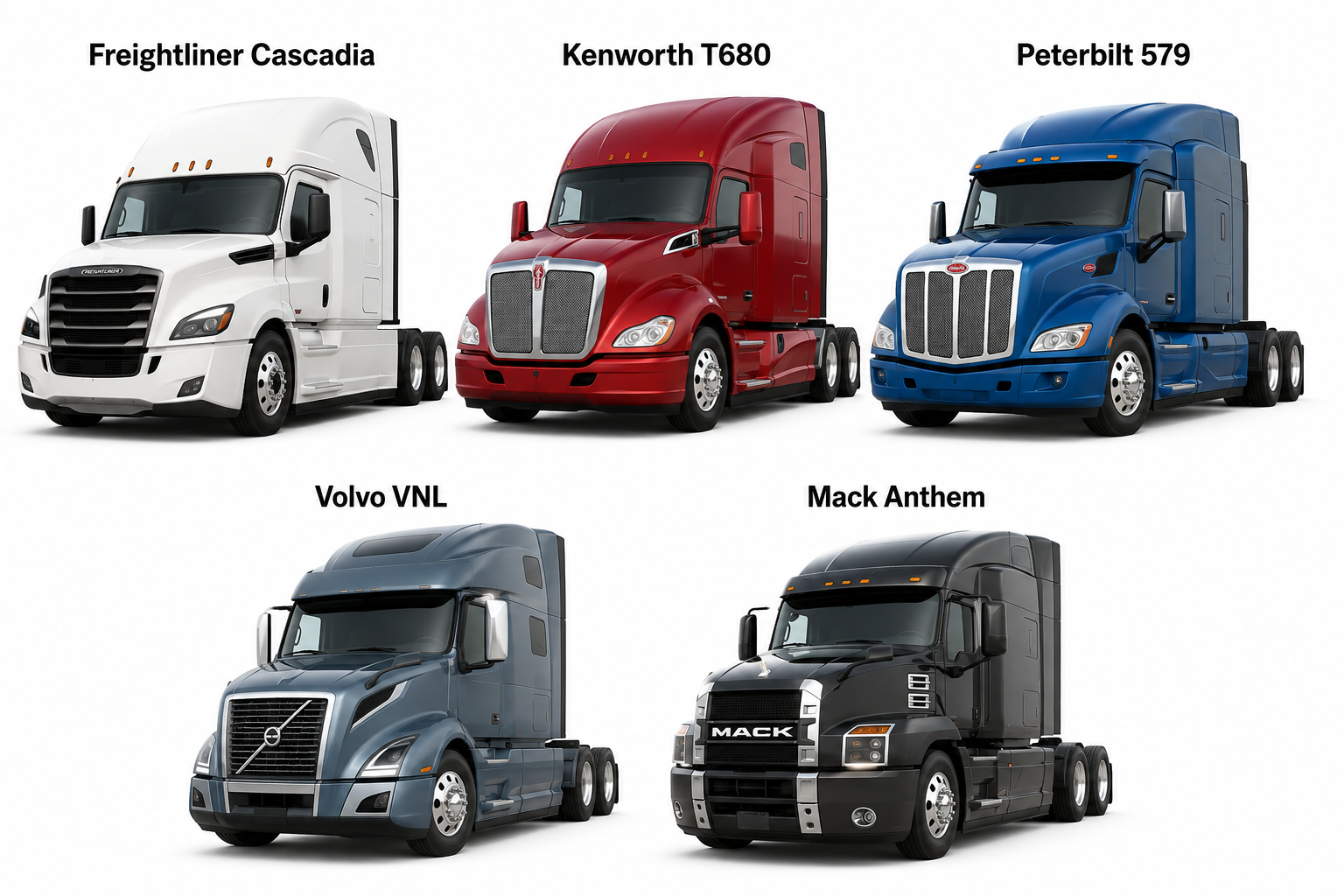
These types of trucks are used across a wide range of transportation work. They handle long-haul routes across states, regional freight distribution, refrigerated cargo that requires temperature control, flatbed hauling for construction materials and machinery, and heavy equipment transport for industries that depend on large-scale logistics.
Because these vehicles are clearly designed for commercial use, they often appear in any practical Section 179 truck list and are strong candidates for deductions when properly documented.
Where Truck Owners Commonly Make Mistakes
Even though Section 179 is widely used in the trucking industry, many owner-operators and fleets do not fully benefit from it because of avoidable mistakes in timing, documentation, and vehicle classification. The rules are not overly complex, but applying them correctly in day-to-day trucking operations is where problems usually start.
Here are the most common mistakes that lead to reduced or lost deductions:
1. Delayed activation after purchase.
A truck must be actively used in business during the tax year. If it is purchased but not dispatched due to insurance delays, repairs, or internal scheduling, it may miss the required “in-service” window.
2. Weak or fragmented documentation systems.
Trucking data is often spread across ELD platforms, fuel cards, and dispatch records. When these systems are not aligned, it becomes difficult to clearly prove business use during review.
3. Incorrect tracking of mixed-use vehicles.
Long-haul trucks are usually straightforward, but pickups and support vehicles often create confusion when business and personal use are not separated clearly.
4. Poor year-end deployment planning.
A truck purchased in December but not placed into active service until the following year may shift the deduction forward, even if the purchase happened in time.
5. Misclassification of vehicle types.
Heavy-duty freight trucks are generally straightforward, but lighter vehicles and support units may fall under different deduction rules or limits depending on classification and use.
6. Inconsistent fleet reporting systems.
In larger operations, different drivers often maintain different reporting habits. Without standardized tracking, proving consistent commercial use across the fleet becomes difficult.
So, Section 179 rewards operational discipline. In a business where equipment is the foundation, smart timing often matters as much as the investment itself.
Good luck!


