



Why Do Truck Camera Systems Matter So Much in 2026?

Truck cameras help prevent the low-speed accidents that make up most truck damage cases. Modern fleets now rely on rear-view, dash, and 360-degree camera systems to reduce blind spots, improve maneuvering accuracy, and record incidents in real time. In many operations, trucks are equipped with 3–6 cameras as standard safety equipment.
This comes down to one simple reality: a truck is only as safe as what the driver can actually see. In close-quarters situations like blind corners, crowded loading docks, or narrow yard spaces, even experienced drivers can’t rely on skill alone.
Visibility becomes the deciding factor between a clean move and a costly mistake.
Quick Summary:
- Around 70%–80% of truck accidents happen at low speeds, often in yards, docks, and parking areas rather than highways.
- Blind spots can extend up to 20–30 feet around a semi-truck, making tight-space maneuvering a major safety risk without camera support.
- Modern fleets now rely on 5+ camera types per truck setup, covering reversing, parking, road incidents, cargo, and environmental conditions.
- Backup and 360-degree systems can reduce low-speed collision risk by up to 40% by improving spatial awareness in confined areas.
- Dash cams and DVR systems are used in over 60% of fleet vehicles in North America for incident proof, insurance claims, and driver accountability.
- Combined camera systems create a 360° visibility layer, improving decision-making speed and reducing preventable operational errors across daily fleet work.
Why Is Visibility So Important for Truck Safety?
Most truck damage does not happen on highways. It happens when the truck is moving slowly, the space is tight, and the driver still cannot see clearly behind or beside the trailer.
Backing into a dock, navigating a crowded yard, or moving near forklifts and pedestrians all create real risk. Even a small misjudgment in distance can lead to damage, delays, and safety problems that affect the whole operation.
A truck backup camera system helps solve that problem by giving the driver a live view of what is behind the vehicle. A truck rear camera system is especially valuable when mirrors stop being enough, and the driver needs more precision in tight spaces.
These systems are commonly used in:
- crowded warehouse yards,
- tight dock entrances,
- city deliveries with limited space,
- trailer coupling,
- early morning or late evening work.
The goal is simple: better visibility leads to better control, and better control reduces mistakes.
Which Truck Camera Systems Solve the Biggest Problems?
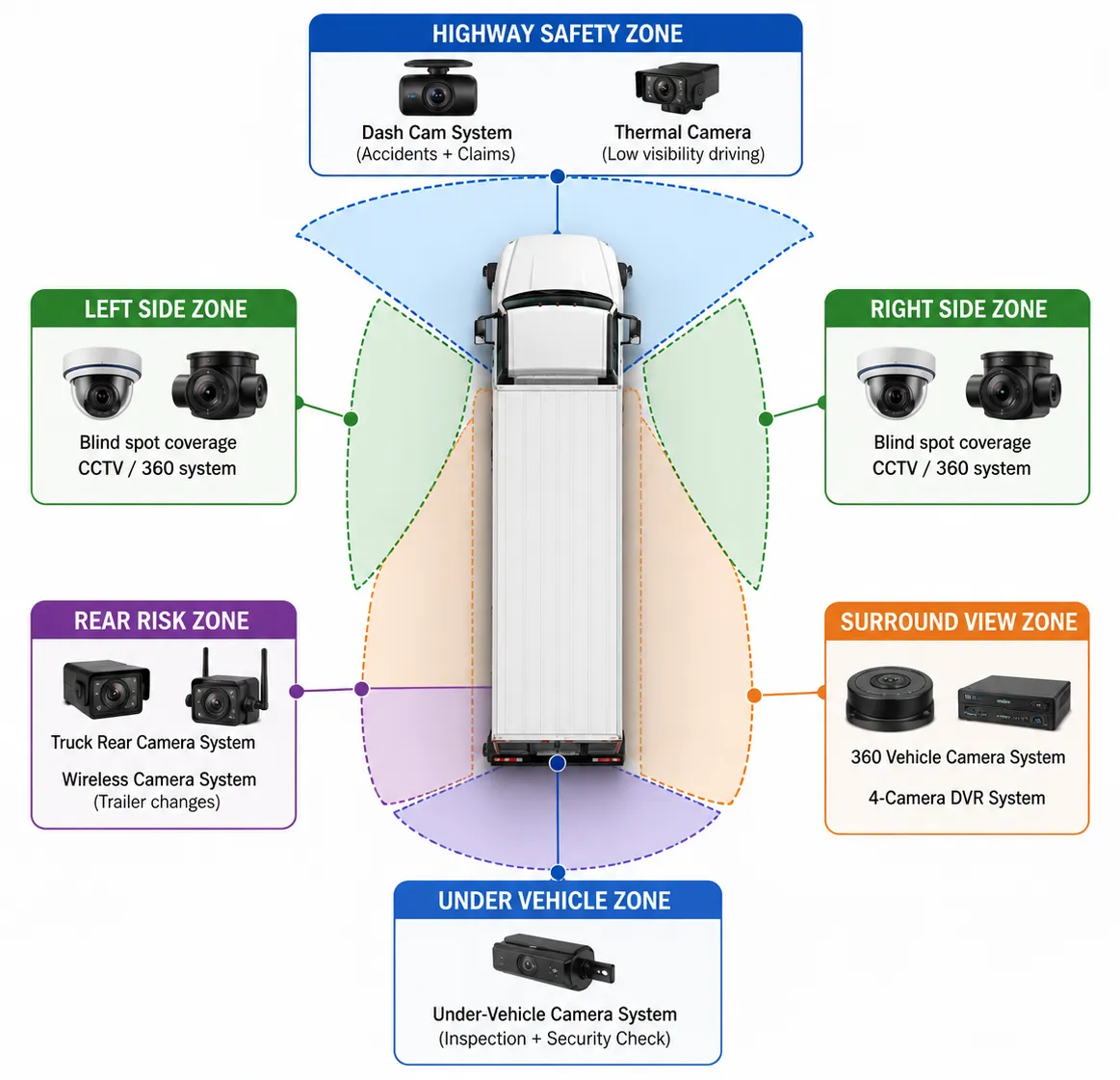
This chart shows how each system protects a different “risk zone” around the truck.
You May Also Like: How Do Different Types of Road Cameras Work?
How Do Backup Cameras Help Drivers Reverse Safely?
A backup camera matters most when the driver is moving slowly and cannot see clearly behind the trailer.
That is the point where mistakes happen. A truck may be backing into a dock, turning in a tight yard, or lining up with a trailer. Without a clear rear view, the driver has to rely too much on angles, mirrors, and guesswork.
A truck backup camera system gives a live image of the rear area, which helps the driver judge distance more accurately. It also reduces hesitation, which is important in busy fleet environments where every second counts.
For many drivers, this is one of the most useful safety tools on the truck because it solves one of the oldest problems in commercial driving: blind rear visibility.
Why Are Wireless Truck Camera Systems Useful for Fleets?
A wireless truck camera system is a commercial vehicle safety setup where cameras transmit live video to a monitor in the cab without using physical video cables between the camera and the display. Instead of running wires through the trailer or truck body, the system uses wireless transmission to send real-time footage to the driver.
In many fleets, one truck connects to several trailers in a single day. If every change requires cables and manual setup, time gets wasted quickly. A truck camera system wireless setup reduces that friction by sending the feed to the cab without a physical connection between units.
That makes wireless systems a strong choice for:
- high-turnover logistics yards,
- mixed trailer fleets,
- fast delivery distribution centers,
- operations with frequent route changes.
The tradeoff is that the signal can sometimes struggle in long trailers or interference-heavy areas. Even so, many fleets choose wireless because the daily time savings are worth it.
How Do Dash Cams Help After Road Incidents?
Dash cams serve a different purpose from backup cameras.
When something happens on the road, people often remember it differently. A sudden lane cut, hard brake, or close merge can become a disagreement in minutes. That is why the best dash cam for a semi-truck is such a valuable tool. It records what actually happened and gives fleets a reliable record for insurance, training, and accountability.
The best dash cam for truck drivers often becomes the deciding factor in claims because memory is not always enough.
Many modern systems can also capture:
- continuous road footage,
- speed and GPS data,
- sudden-impact events,
- night driving in low light,
- behavior patterns for fleet review.
That makes dash cams useful not only for evidence, but also for improving driver awareness and fleet management.
Choosing the right system depends on how the truck is used, whether it’s a single-owner operator setup or a full fleet operation. In practice, the best system is the one that matches coverage needs, complexity, and whether fleet monitoring is required.
What Is the Best Dash-Cam For Truckers?
Why Is a 360-Degree Camera System So Helpful in Tight Spaces?
When trucks operate in tight yards, loading docks, or crowded urban routes, blind spots become the real risk factor. A 360-degree or multi-channel camera setup helps close those gaps by giving a complete view around the vehicle, reducing guesswork during low-speed maneuvers and preventing minor contact incidents that can turn into costly claims.
Instead of forcing the driver to switch between separate camera views, it creates a unified overhead perspective of the truck and its surroundings. That makes it much easier to maneuver in confined spaces, especially when parked equipment, walls, or other trucks leave very little room to work with.
This system is especially useful in:
- tight yard parking,
- sharp turns between parked equipment,
- warehouse navigation,
- confined loading zones,
- driver training situations.
A 360 system does not just improve visibility. It improves confidence. Drivers often feel less stress when they can see the whole vehicle area at once.
How Do Thermal Cameras Improve Visibility in Bad Weather?
Some driving conditions make normal vision fail.
Fog, snow, dust, smoke, and darkness can all reduce visibility to the point where the driver sees very little. That is where thermal cameras become useful. Instead of relying on reflected light, they detect heat, which means movement can still be seen even when the road is hard to read.
A vehicle mounted thermal imaging camera system is especially valuable in:
- dense fog,
- snowstorms,
- rural roads with wildlife,
- construction zones with dust or smoke,
- night driving in unlit environments.
You May Also Like: Live Road Cameras: Plan Your Route with Trucker Guide

The biggest benefit is time. A few extra seconds of warning can make the difference between a safe reaction and a dangerous surprise.
Why Are DVR Camera Systems Still So Reliable?
A DVR camera system is a vehicle security and safety setup that records video from one or multiple cameras and stores the footage locally inside the truck using a digital recorder, without requiring an internet connection. In trucking, it is commonly used to continuously record road activity, driver behavior, and vehicle surroundings for safety, compliance, and incident review.
Many fleets still trust DVR systems because they offer:
- no dependence on network or cloud services,
- stable recording in remote driving conditions,
- simple installation and maintenance,
- lower operating costs,
- consistent performance under heavy use.
For many businesses, DVR systems are the foundation of a complete truck camera setup because they keep working when connectivity is weak.
What Should Fleet Owners Remember?
Truck camera systems are not about replacing driver skill. They are about giving skilled drivers better information.
Even the best driver cannot see through blind spots, fog, trailer corners, or poor lighting. Cameras fill in the gaps that human vision cannot cover, which is why they have become such an important part of modern trucking.
For drivers, that means more confidence and less stress. For fleets, it means fewer accidents, fewer disputes, and better oversight. In 2026, visibility is no longer an extra feature. It is part of safe, modern trucking.
Each one solves a specific visibility gap. Together, they create a full protective layer that supports drivers in nearly every real-world scenario they face on the road and in the yard.


